One of the Best Decisions to Make for Your Large Breed Dog
Don't take this decision lightly. Choosing the wrong approach may increase your dog's risk of disease, discomfort, or reduced longevity. The following recommendations are intended to support the health and well-being of large-breed dogs.

Reviewed by Dr. Becker




Join the Bark & Whiskers™ Family
Sign up today for our FREE newsletter, packed with expert advice and insider tips to keep your beloved pet in tip-top shape.
View our Privacy Policy and Terms of Service.



STORY AT-A-GLANCE
- There’s research suggesting that large breed dogs who are spayed or neutered are 50% to 100% more likely to grow overweight or obese
- The same study found that dogs desexed before 6 months of age had a 300% greater risk of sustaining nontraumatic orthopedic injuries
- Previous studies have shown that spaying/neutering large and giant breeds increases the risk for many other diseases as well, including several types of canine cancer
- A sterilization procedure that spares the ovaries or testes may be preferred; however, there are relatively few veterinarians in the U.S. trained to perform sterilization rather than traditional spay/neuter procedures
- If no options are available beyond a full spay or neuter, it may be beneficial to wait until a large or giant breed dog has reached full musculoskeletal maturity — and for females, until after the first estrus cycle, or preferably a second cycle
Editor's Note: This article is a reprint. It was originally published September 8, 2019.
According to newly published research based on data collected in the ongoing Morris Animal Foundation Golden Retriever Lifetime Study, spaying or neutering large breed dogs can increase their risk for obesity. In addition, if the spay/neuter is performed when the dog is young, it also increases the risk for nontraumatic orthopedic injuries.1
"For years, we’ve been taught that spaying or neutering your dog is part of being a responsible pet owner, but there really are advantages and disadvantages to consider when making that decision,” said lead study author Dr. Missy Simpson in a Morris Animal Foundation news release.
"Our study results give dog owners and veterinarians new information to consider when deciding on when to spay or neuter their dog, especially when considering the long-term health of their pet.”2
Spay/Neuter Surgery Increases the Risk for Overweight/Obesity and Nontraumatic Orthopedic Injuries
Estimates are that one-third to one-half of all large breed dogs are overweight or obese. Roughly 2% of these dogs suffer nontraumatic orthopedic injuries, such as cruciate ligament ruptures. For this study, the researchers analyzed health data collected over six years from more than 3,000 golden retrievers, about half of which had been spayed or neutered.
The researchers reported in their published study that Goldens who were spayed or neutered were 50% to 100% more likely to grow overweight or obese, but the age at which they were desexed didn’t appear to have an influence on this outcome. However, when Simpson previewed the study results a year ago, she reported that age of spay/neuter was indeed a factor:
“Compared to intact dogs, dogs that underwent gonadectomy when they were 1 year old or younger faced a two-times higher risk for overweight or obesity. Dogs older than 1 year had a 40% increased risk for overweight or obesity. Further, Dr. Simpson shared that for every year older the dog was when gonadectomy occurred, it reduced the risk of overweight and obesity by 70%.”3
This statement suggests that the risk of overweight or obesity decreases the older a dog is at the time of desexing. That makes it unclear why there’s a discrepancy between the initial report and the findings presented in the newly published study.
When it comes to nontraumatic orthopedic injuries, the study results show that the age at which a spay or neuter is performed appears to be a significant factor. Specifically, dogs desexed before 6 months of age had a 300% greater risk of sustaining those types of injuries.
Other Studies of Large Breed Dogs Suggest Broader Health Risks with Spaying and Neutering
In the U.S., dogs are routinely spayed or neutered when they’re between 4 and 9 months old. According to Dr. Clara Goh, surgical oncologist at Colorado State University’s Veterinary Teaching Hospital, writing for Clinician’s Brief:
“The decision to perform this procedure is often based on convention, habit, or misconception of health benefits rather than on an evidence-based assessment of each patient.”4
Over the last several years, a number of small, breed-focused, primarily retrospective studies have been conducted on the effects of spay/neuter in large and giant breed dogs, including the Rottweiler and golden retriever. Goh provides the following information to illustrate what the research has uncovered about the potential benefits and adverse effects of gonadectomy:
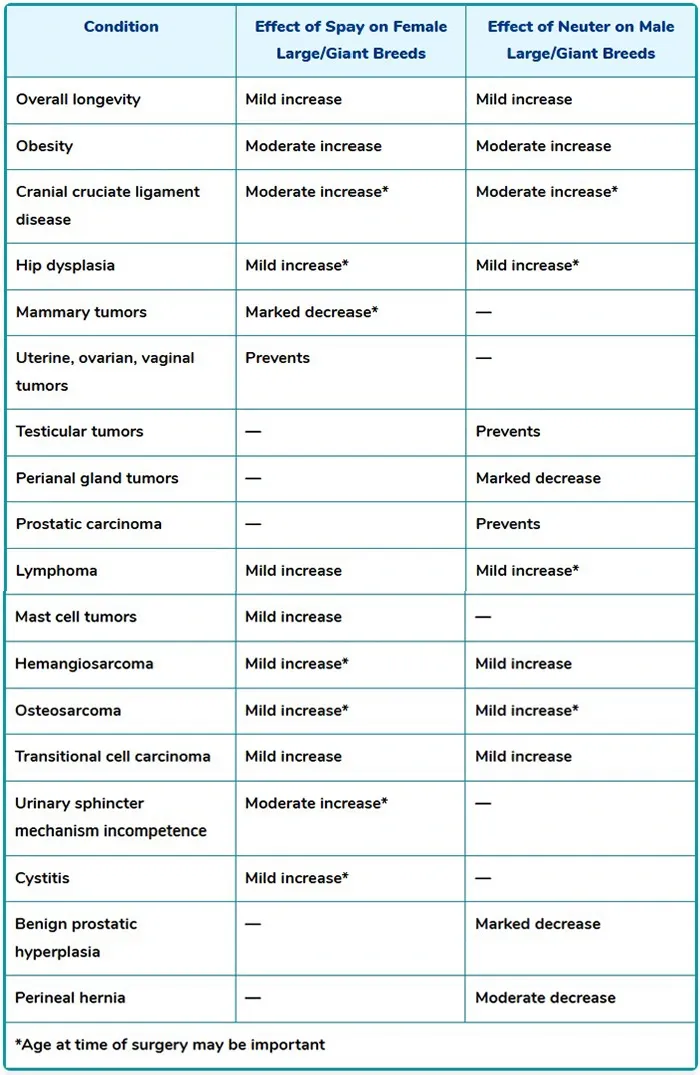
What the above table illustrates is that spay/neuter of large and giant breed dogs decreases or prevents most reproductive organ disease, as you would expect, since conventional desexing surgery removes some or all of those organs and the hormones they produce.
The diseases for which spayed or neutered dogs are at increased risk are, as you also might expect, some of the most common disorders seen in dogs today. They include obesity, cranial cruciate ligament (CCL) ruptures, hip dysplasia, several types of cancer, urine dribbling (incontinence) and cystitis (bladder inflammation).
Musculoskeletal Disorders in Desexed Large/Giant Breeds
Early age gonadectomy removes a dog’s ability to produce important hormones while his or her skeleton is still developing and can result in delayed closure of the growth plates at the end of each long bone. This can cause a dog’s legs to grow longer than normal. As you can see in this example of two adult male golden retrievers, the big guy on the left is intact, with normal conformation for the breed. The leggier guy on the right was neutered at 5 months and has a quite noticeable longer-limbed conformation.
Sadly, even though the taller golden on the right is certainly as handsome and fit-looking as the dog on the left, his longer limbs may put him at a higher risk for orthopedic disease. Labrador and golden retrievers neutered before 6 months of age develop one or more joint disorders at two to five times the rate of intact dogs.5
When it comes to problems with cranial cruciate ligaments, large breed dogs spayed or neutered at under 6 months of age have three times the risk for early life CCL injuries.6 Dogs desexed at any age have a two to three times higher incidence of CCL disease compared with intact dogs.7,8
In a study of several hundred golden retrievers, none of the intact dogs had CCL disease; however, 5% of neutered males and 7.7% of spayed females who were desexed before they were a year old developed CCL injuries.9 The body condition score was the same for all the dogs, which indicates that changes in the build of the desexed dogs was to blame.
Male golden retrievers neutered at under 1 year developed hip dysplasia at double the rate of intact males, and the disease also appeared earlier in the desexed dogs.10 Another study wherein 40 years’ worth of data was collected from a range of different dogs desexed at a variety of ages showed a 17% increased risk of hip dysplasia.11
Cancers Linked to Spaying and Neutering in Large and Giant Breeds
Studies have shown that intact large and giant breed dogs have a lower risk for developing lymphoma than spayed or neutered dogs. Another risk factor for lymphoma is desexing before the age of 1.12 Spaying/neutering is also associated with a two to four times greater risk for mast cell tumors.13
In a study of Rottweilers, both males and females who were desexed before they were a year old had a 1-in-4 lifetime risk for bone cancer, and in general, spayed or neutered dogs were significantly more likely to develop the disease than intact Rotties.14
In another study conducted during the period of 1980 through 1994, the risk for bone cancer in large breed, purebred dogs increased twofold for dogs that were spayed or neutered.15 Desexed dogs also have a three times greater risk of developing transitional cell carcinoma of the bladder than intact dogs.16,17
Useful Sterilization Recommendations
Over the years, perspectives on spaying and neutering dogs have evolved based not just on a growing body of research, but also on the health challenges observed in many canine patients after desexing. As a result, a more individualized approach can help guide decisions that provide the greatest overall health benefits for each dog.
Whenever possible, leaving dogs intact may be preferred. However, this approach requires a highly responsible pet guardian who is fully committed to and capable of preventing the dog from mating (unless the owner is a responsible breeder and that is the goal).
It’s important to note that this does not advocate the adoption of intact shelter animals to people who may or may not be responsible pet owners. Shelter veterinarians often have limited time and resources to build relationships with every adoptive family, so animals in their care may be sterilized prior to adoption to prevent additional litters of unwanted pets.
A second option is sterilization without desexing. This involves performing a procedure that prevents pregnancy while preserving the testes or ovaries so they can continue to produce hormones essential for the dog’s health and well-being.
This typically includes a vasectomy for male dogs, and either a tubal ligation or modified spay (hysterectomy) for females. The modified spay removes the uterus while preserving the hormone-producing ovaries. It also eliminates the possibility of pyometra because the uterus is removed.
In some cases, older, intact male dogs develop moderate to severe benign prostatic hyperplasia (an enlarged prostate), which may improve with conventional neutering. Generally speaking, mature intact dogs have had the benefit of long-term sex hormone production, so the endocrine imbalances seen with early spaying or neutering are less likely to occur when desexing is performed later in life.
Unfortunately, veterinary schools in the U.S. primarily teach full spays and neuters, so unless a veterinarian has obtained additional training in sterilization techniques that spare the ovaries or testicles (which may be less common), only one option may be available for sterilization. In that case, it may be beneficial to wait until a dog has reached full musculoskeletal maturity. For females, waiting until after the first estrus cycle, or preferably a second cycle, may also be considered before scheduling surgery.
Sources and References
- dvm360, August 2, 2019 (Archived)
- 1 PLOS ONE, July 17, 2019
- 2 Morris Animal Foundation News Release, July 17, 2019
- 3 dvm360, August 21, 2018 (Archived)
- 4 Clinician's Brief, August 2016
- 5 PLOS ONE, July 14, 2014 (Archived)
- 6 JAVMA. 2007 Dec 1;231(11):1688-91
- 7, 11 JAVMA. 2008 Jun 15;232(12):1818-24
- 8 Clin Orthop Relat Res. 2004;(429):301-305
- 9, 10 PLoS One. 2013;(8)2:e55937
- 12 J Cancer Epidemiol. 2009:591753
- 13 JAAHA. 2011;47:210-216
- 14 Cancer Epidemiol Biomarkers Prev. 2002 Nov;11(11):1434-40
- 15 Vet J. 1998 Jul;156(1):31-9
- 16 JVIM. 1992;6(3):145-153
- 17 JVIM. 2003;17(2):136-144

Better Health Begins in the Bowl

Better Health Begins in the Bowl
The Ultimate Pet Nutrition Guide was created to help dog and cat parents understand what truly supports lifelong health.
In this free guide, you’ll discover:
-

How your pet’s biology influences their nutritional needs
-
Why conventional feeding advice often falls short
-
Practical ways to choose better food for your dog or cat
View our Privacy Policy and Terms of Service.