Is Your House Cat Wilder Than You Think?
Your cat’s daily habits — from hunting to sleeping — come straight from their wild ancestors. Here’s what that means, and how it can help you take better care of them.
Reviewed by Dr. Arielle Walton




Join the Bark & Whiskers™ Family
Sign up today for our FREE newsletter, packed with expert advice and insider tips to keep your beloved pet in tip-top shape.
View our Privacy Policy and Terms of Service.


STORY AT-A-GLANCE
- House cats descended from African wildcats and largely domesticated themselves about 10,000 years ago by hunting rodents drawn to stored grain near human settlements
- Domestic cats and big wild cats are obligate carnivores that share stalking, waiting, pouncing, and other hunting behaviors
- Both use scent and similar physical traits to navigate their surroundings, including territorial rubbing, powerful noses, flexible paws, retractable claws, and sensitive paw pads
- Cats of all sizes are most active around dawn and dusk, often prefer solitude, and use play to practice essential hunting and social skills
- Puzzle feeders, hidden food, climbing spaces, window perches, scent trails, rotating toys, and quiet retreats help satisfy your cat’s wild instincts and support their overall well-being
Have you ever watched your cat pounce on a ball of yarn and thought, “That’s basically a tiny lion”? It might sound like proud pet-parent exaggeration, but there’s more truth to that comparison than you might think.
In fact, your house cat and the big cats of the wild, like lions, tigers, and cougars, share a surprising number of traits. Knowing what these are can help you understand your own cat a little better.1
How Your Couch Potato Descended from a Wild Hunter
The cat lounging on your sofa today isn’t far removed from its wild ancestors. Domestic cats descended from the African wildcat (Felis lybica or Felis silvestris lybica), a species that still roams regions of Africa and the Middle East. Unlike dogs, whose appearance and behavior changed dramatically through centuries of selective breeding, cats remain surprisingly similar to their wild relatives.2
Even more fascinating is how cats came to be part of human society in the first place. Scientists believe they largely domesticated themselves. Around 10,000 years ago, people began storing grain, which attracted mice and rats. Wildcats came to hunt these rodents, and the cats that were most comfortable around people had the best access to food. Over many generations, the cats that tolerated humans the most remained nearby and eventually became the domestic cats we know today.
8 Similarities Between House Cats and Big Cats
Now that you know your cat’s wild backstory, the rest of their quirks start to make more sense. Here’s a closer look at the behaviors that connect your house cat to the powerful felines in the wild today.3,4,5
- They’re obligate carnivores — Big cats and house cats are both built to run on meat and little else. Both have short digestive tracts designed to break down protein and fat quickly, and that same digestive system struggles to process plant matter, which is why a nibble of grass or catnip doesn’t provide real nutrition.
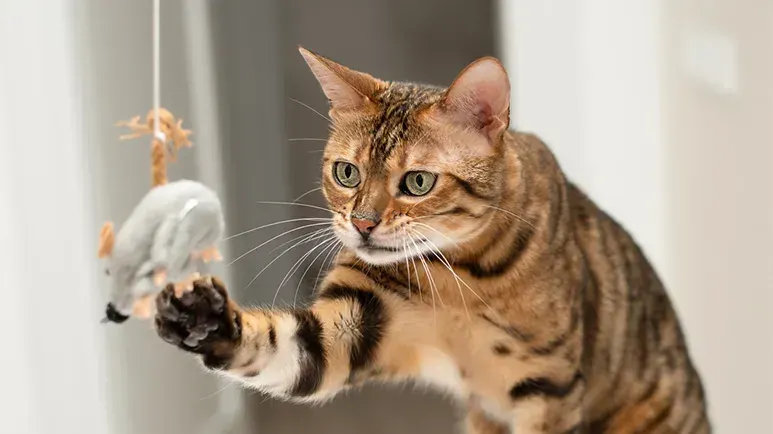
- They still think like hunters — That crouch-and-pounce move your cat does isn’t just a cute quirk; it’s part of a deeply ingrained hunting instinct. Even when food is always available, cats remain motivated to stalk, wait, and pounce because they find the activity itself rewarding.6
This same drive can be seen in their larger wild relatives. Both big cats and house cats spend time watching, waiting, and practicing the skills needed to make a successful strike. These behaviors remain an important part of a cat’s natural repertoire, regardless of whether they live in the wild or spend their days lounging indoors. - They mark territory the same way — The next time your cat rubs against your leg, know that they’re doing the same thing a tiger does when it rubs against a tree. Cats deposit scent from glands on their body when they rub against something, marking it as their territory, whether the “something” is a fence post in the wild or your ankle at home.
- They have an incredibly powerful sense of smell — None of that territory-marking works without a powerful sense of smell. A cat’s nose is up to 14 times more sensitive than a human’s, allowing it to pick up scent trails left behind by other animals or carried through the air. That sense of smell also helps cats gather more personal information, such as whether a nearby cat is looking for a mate or guarding its territory.
- Their claws and paws work the same way — Like wild cats, domestic cats have four toes on their back feet and five on their front feet. Both big cats and house cats have flexible paws with retractable claws, which help keep those sharp points from wearing down as they walk.
The cheetah is the one exception, with semi-retractable claws built for speed rather than climbing. Their paw pads are also packed with nerve endings, making them sensitive enough to detect texture, temperature, and even vibrations. - They’re wired to be most active at dawn and dusk — Your cat’s sleep schedule isn’t random. Cats are naturally most active at dawn and dusk, which helps explain those late-night hallway sprints. Lions and cougars follow a similar rhythm, sleeping up to 15 hours a day and relying on excellent night vision to move around in low light.
- Not everything lines up — Most cats have 38 chromosomes per cell; the Geoffroy's cat and the ocelot are the only exceptions, with 36. Unlike lions and tigers, pumas can purr because of differences in how the larynx connects to the skull.
- They’re naturally solitary, but they still love to play — Big cats tend to be loners, just like most domesticated cats. Giving your cat a quiet space to retreat to can help reduce stress and support their overall well-being.
That said, cats of all sizes still make time to play. Wild cubs wrestle with their littermates and stalk one another to practice social and hunting skills, and your cat chasing a feather wand is doing much the same thing.
How to Let Your Cat’s 'Wild Side' Thrive
Once you see how much of a wild hunter is still living under your cat’s fur, it becomes a lot easier to understand what they need day to day. Many of the same approaches used to keep big cats healthy in captivity can also help support the physical and mental well-being of domestic cats. Here are a few helpful tips to keep in mind:7
- Let them work for their food — Instead of leaving a full bowl out all day, try a slow feeder or hide small amounts of food around the house. This taps into your cat’s natural hunting instinct, keeps mealtime more interesting, and can help manage their weight.
- Give them room to climb and roam — Wild cats patrol real territory, and while your cat’s territory is your living room, that instinct to explore and survey their space hasn’t gone anywhere. Shelves, window perches, and a cat tree go a long way toward satisfying it.
- Keep their mind busy — Big cats in zoos need mental stimulation to stay well, and the same goes for the cat on your couch. Puzzle feeders, scent trails, and rotating toys give them the kind of enrichment their instincts are still asking for.
Your cat may spend most of the day curled up asleep on the couch, but there’s still a small wild hunter in there, and it shows up more often than you might expect. Paying attention to those instincts, instead of working against them, is one of the simplest ways to help your cat feel more like themselves. As always, loop in your veterinarian about what’s right for your individual cat’s health and behavior.
Sources and References

Better Health Begins in the Bowl

Better Health Begins in the Bowl
The Ultimate Pet Nutrition Guide was created to help dog and cat parents understand what truly supports lifelong health.
In this free guide, you’ll discover:
-

How your pet’s biology influences their nutritional needs
-
Why conventional feeding advice often falls short
-
Practical ways to choose better food for your dog or cat
View our Privacy Policy and Terms of Service.