Your Dog Is Being Very Intentional When He Does This
If you were a dog and wanted to get your humans to do something for you, how would you communicate? Turns out dogs' gestures aren't as random as you might assume. These are the ones used most often for four particular purposes. How well do you respond to them?

Reviewed by Dr. Becker




Join the Bark & Whiskers™ Family
Sign up today for our FREE newsletter, packed with expert advice and insider tips to keep your beloved pet in tip-top shape.
View our Privacy Policy and Terms of Service.


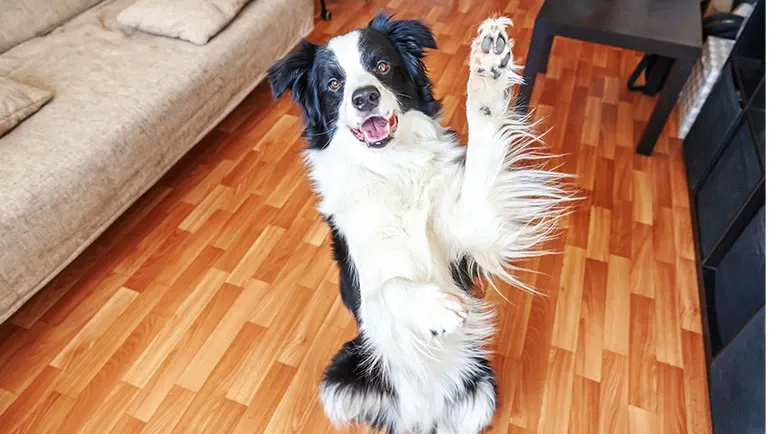
STORY AT-A-GLANCE
- Research proves beyond a doubt that dogs gesture to their humans to get things they want or need
- The researchers arrived at 19 referential (pointing) gestures dogs perform to achieve certain things, including the head turn, the roll over and the paw hover
- Most dog gestures are designed to achieve one of four goals: to be given food or drink, to be let outside, to be given a toy or bone, or to be scratched
- The more humans a dog lives with, the more gestures in his repertoire
- Dogs are the only species that not only use gesturing to communicate with another species (humans), but also employ such a wide range of gestures
Editor's Note: This article is a reprint. It was originally published August 20, 2018.
Like most dog parents, you're keenly aware of which verbal cues and physical gestures your four-legged family member is most likely to respond to. But how often do you think about or even notice the signals your dog uses to get a response out of you? As it turns out, our canine companions are extremely proficient at persuading us to do their bidding, and a new study published in the journal Animal Cognition provides some fascinating insights into yet another skill at which dogs excel.1
Study Says — Dogs Use a Variety of Pointing Gestures to Ask for Things from Their Humans
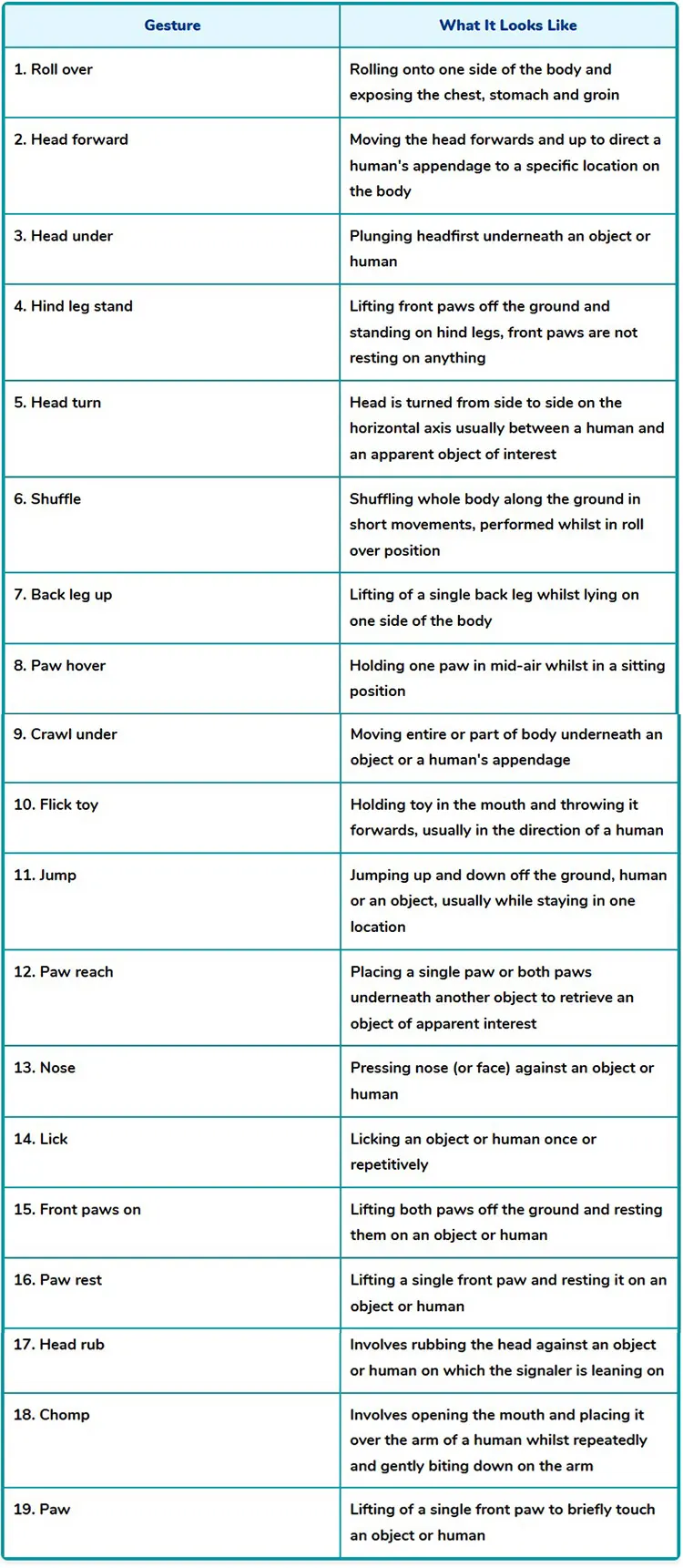
Two biologists at the University of Salford School of Environment & Life Sciences in Manchester (U.K.) have identified 19 gestures dogs make to humans and the behavior they expect in return. In addition, our furry friends often give us a "hurry up" signal when our response takes too long, or switch to a different gesture to get us moving!
The researchers deliberately flipped the script on the usual studies examining dogs' ability to understand humans by looking at doggy gestures and how well humans perform in response to them.
"What we see is how dogs are really adept at using what's termed 'referential gestures' which in the human world are things like pointing and waving," explains Ph.D. researcher and study co-author Hannah Worsley. "For instance, we found that when dogs want a scratch, they use as many as 14 different gestures to coax their owners to do it."2
Referential (pointing) gestures are used to draw attention to a specific object, individual or event in the environment. For their citizen science project, the research team recruited 37 volunteer dog parents and asked them to use their mobile phones to collect videos of their pets communicating with them in everyday situations over a period of several weeks.
The group of dogs ranged in age from 18 months to 15 years, and included 21 males and 16 females. All the dogs had lived with their humans for at least five months prior to the study. The researchers then analyzed over 1,000 video clips and whittled the dogs' behaviors down to 47 potential referential gestures. Next, they narrowed their list to 19 gestures that met the five criteria of referential signaling:
- The gesture is directed toward an object or specific area of the signaler's body (the signaler in this case is the dog)
- The gesture is aimed at a potential recipient
- The gesture receives a voluntary response
- The gesture is mechanically ineffective
- The gesture has intention
The 19 Gestures
Most Doggy Gestures Are a Request for One of These 4 Things
Next, the researchers placed the gestures into four categories based on their "apparent satisfactory outcome," defined as the dog wanted something, gestured to a human and the human responded in a way that ended the gesture. The four categories the researchers settled on were:
- Give me food/drink
- Open the door
- Fetch my toy/bone
- Scratch me
The most common signal the dogs gave was the head turn (No. 5 in the chart), which was recorded 381 times, and was used to achieve all four outcomes. Thirty-five of the 37 dogs used it. The paw hover (No. 8) was used most often to ask for food or drink; the roll over (No. 1) was used 100% of the time to say "Scratch me" and the head under maneuver (No. 3) was invariably used to say "Fetch my toy/bone."
The researchers also observed that the dogs' use of their nose (No. 13) could signal any of the four requests. In addition, both the number of people in the household, and the length of time the dog had lived with those people influenced the gestures the dog used.
"We see how dogs with a larger number of people to communicate with possess a greater number of gestures to call upon since they have had more opportunities to learn," says Worsley. "This implies that dogs are very much aware that they can't just make a gesture, they also need to ensure that gesture is understood by the recipient, and if necessary make it easier or clearer for the message recipient."
"What is clear," adds Worsley, "is that after 30,000 years of cohabitation, dogs and their human companion have become skilled at identifying and understanding each other's referential cues. Perhaps another reason why man and dog seems to be such a satisfying relationship."
How Many Referential Gestures Does Your Dog Use to Communicate with You?
Just in case any of you reading here today don't fully understand the significance of this study and what it says about your dog, here’s what it means.
Referential gestures are considered incredibly rare in nonhuman species. Apes use a couple of different signals to communicate with one another, and occasionally with human caretakers in the case of captive apes. There are also reports of limited gesturing among birds and certain species of fish, but again, the signals are used only to communicate with others of their kind.
Referential gesturing by one species to another species is almost unheard of, and no other species possesses the incredibly wide variety of gestures domesticated dogs do when communicating with people. There are plenty of studies showing dogs are uniquely skilled at understanding our communication gestures, but this study is the first to show that dogs also use an impressive array of gestures to communicate with us. And perhaps best of all, just as they understand our nonverbal signals, we understand theirs as well.
Sources and References

Better Health Begins in the Bowl

Better Health Begins in the Bowl
The Ultimate Pet Nutrition Guide was created to help dog and cat parents understand what truly supports lifelong health.
In this free guide, you’ll discover:
-

How your pet’s biology influences their nutritional needs
-
Why conventional feeding advice often falls short
-
Practical ways to choose better food for your dog or cat
View our Privacy Policy and Terms of Service.