Dogs Mimic Their Owners' Facial Expressions
Dogs are closely in tune with the emotions of dogs around them, mimicking behaviors like play bows and open-mouthed grins. It turns out this mimicry likely extends to humans, too, according to research that adds credence to the notion that dogs are capable of showing empathy.

Reviewed by Dr. Becker




Join the Bark & Whiskers™ Family
Sign up today for our FREE newsletter, packed with expert advice and insider tips to keep your beloved pet in tip-top shape.
View our Privacy Policy and Terms of Service.


STORY AT-A-GLANCE
- Dogs were found to display rapid mimicry of the other dogs’ body movements, particularly a play bow, and facial expression (a relaxed, open mouth)
- Dogs were more likely to mimic familiar, socially bonded companions. Rapid mimicry occurred in 77% of dogs, extended play sessions, and may reflect empathy-like emotional contagion that strengthens relationships
- Within less than one second of seeing another dog play bow or relax their facial expression, many of the dogs responded in suit, copying the other dog’s expression or behavior
- The dogs’ level of familiarity with one another affected their level of mimicry; dogs that already knew each other and were socially bonded were more likely to mimic each other
- Dogs can likely mimic their owners’ facial expressions as well, especially if they’re closely bonded
Editor's Note: This article is a reprint. It was originally published January 26, 2017.
Are dogs empathetic beings, capable of experiencing others' emotions? Very likely, yes, according to research published in the journal Royal Society Open Science.1 The study involved dozens of dogs, which were observed at a dog park in Italy.
Many of the dogs were found to display rapid mimicry of the other dogs' body movements, particularly a play bow and facial expression (a relaxed, open mouth).
Within less than one second of seeing another dog play bow or relax their facial expression, many of the dogs responded in suit, copying the other dog's expression or behavior.
What's more, the dogs' level of familiarity with one another affected their level of mimicry. Dogs that already knew each other and were socially bonded were more likely to mimic each other. "The stronger the social bonding, the higher the level of rapid mimicry," the researchers wrote.2
The findings are incredibly intriguing, because facial mimicry in humans and non-human primates is a form of emotional contagion that is regarded as a basic form of empathy.
Overall, a high level of rapid mimicry was observed in a mean of 77% of the dogs, which reacted after perceiving play bows or a relaxed, open mouth facial expression.3
When the dogs mimicked each other, their play sessions lasted longer, which suggests it increased the dogs' motivation to play and possibly strengthened the dogs' relationship.
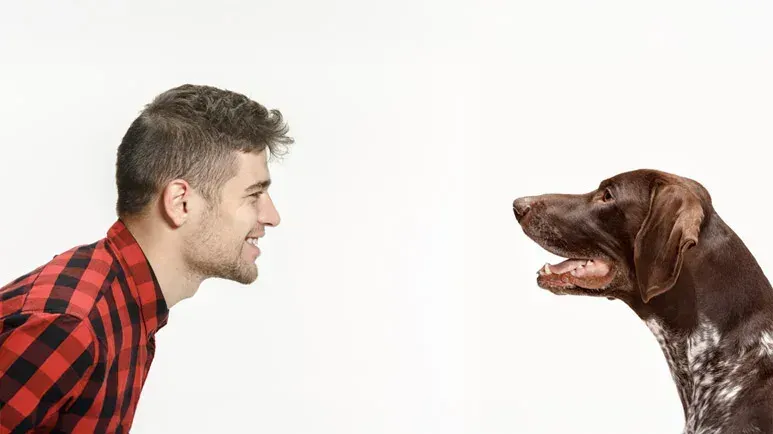
Dogs May Mimic Owners' Facial Expressions, Too
If you smile at your dog, does he smile back? The researchers believe, given their findings that dogs mimic the emotional states of other dogs, that dogs can mimic their owners' facial expressions as well, especially if they're closely bonded. Seeker reported:4
"'It is an automatic response, similar to that of humans when they see someone crying or smiling,' [lead author Elisabetta] Palagi [,Ph.D.,] said, adding that domestication probably even enhanced dogs' natural inclination toward emotional contagion all the more."
The totality of evidence is showing that dogs have many complex ways of communicating with and understanding not only other dogs but also humans.
The researchers pointed out that dogs follow others' gaze, head and body orientation, and combine body postures, including head and tail movements, to communicate their emotional states.
They also use their eyes, lips and teeth expressively and "regularly express their positive emotional states via specific signals that are performed through both the face (relaxed open mouth … and the body (play bow)."
Further, dogs can discriminate between emotional expressions on human faces and body postures. For instance, research published in Biology Letters found dogs recognize both dog and human emotions.5
The dogs were presented with either human or dog faces with different expressions (happy and playful versus angry and aggressive). The faces were paired with a vocalization that was positive, negative or neutral.
The dogs looked significantly longer at the faces that matched up to the appropriate vocalization, which is an ability previously thought to be distinct to humans.
Past research has also found dogs automatically imitate their owner's use of either their head or hand (or paw) when opening a sliding door, closely mimicking their owner's behavior even if doing so would cost them a reward (a treat).6
Dogs May Grasp the Meaning Behind Your Facial Expressions
It's quite possible that dogs are not only capable of mimicking their owners' facial expressions but also of understanding what the expression means, emotionally.
For starters, past research revealed spikes of oxytocin, i.e., the love hormone, are triggered by mutual gazes between a dog and his owner.7 Increased eye contact between dog-owner pairs led to higher levels of oxytocin.
Mimicry, which is based on and facilitated by such mutual gazing, likely has "a direct function in this emotional positive loop by connecting the dogs and fostering their social attachment," the researchers wrote. They continued:8
" … [T]hrough experience gained by social interactions with their owners, dogs are able to form a huge variety of memories of human facial expressions that goes beyond the purely perceptual level …
[T]he ability to finely discriminate facial expressions also implies the possibility that dogs are able to catch the emotional meaning underpinning such specific facial expressions.
… All these findings concur in supporting the idea that a possible linkage between rapid mimicry and emotional contagion (a basic form of empathy) exists also in dogs."
The researchers suggested that studying wolves may yield clues about whether rapid mimicry also exists in non-domesticated species, and therefore if dogs' close ties with humans have played a role in this phenomenon.
Perhaps not surprisingly, it's known that dogs recognize their owners' faces and pay close attention to their cues in order to gauge their emotions. The next time you sit down with your dog, you can conduct an experiment of your own by acting playful and seeing if your dog acts playful in response.
Most likely, you'll find that your dog is quite adept at "catching" your emotions, so if you're not in the mood for playtime, try getting him to imitate a different behavior, like curling up on the couch.
Sources and References

Better Health Begins in the Bowl

Better Health Begins in the Bowl
The Ultimate Pet Nutrition Guide was created to help dog and cat parents understand what truly supports lifelong health.
In this free guide, you’ll discover:
-

How your pet’s biology influences their nutritional needs
-
Why conventional feeding advice often falls short
-
Practical ways to choose better food for your dog or cat
View our Privacy Policy and Terms of Service.