Could Their Whiskers Have an Opinion About That Bowl?
If your cat paces around a full bowl or stubbornly drinks from the faucet instead of their own water dish, you probably assume they’re just being dramatic. But there’s another possibility worth considering — here’s what it is, how to spot it, and the no-cost swap that often fixes it within days.
Reviewed by Dr. Arielle Walton



Join the Bark & Whiskers™ Family
Sign up today for our FREE newsletter, packed with expert advice and insider tips to keep your beloved pet in tip-top shape.
View our Privacy Policy and Terms of Service.


STORY AT-A-GLANCE
- If your cat paces around a full bowl, paws kibble onto the floor, or drinks from the faucet instead of its water dish, the problem may not be pickiness; it may be the bowl's shape
- A cat's whiskers are packed with nerves and roughly as sensitive as a human fingertip; when they repeatedly brush the sides of a deep, narrow bowl, the constant sensory input can tip into overload at mealtime
- Veterinary sources from VCA Animal Hospitals to Oklahoma State University describe this "whisker fatigue" as a real physical mechanism, not a formal diagnosis, but a design problem with genuine sensory consequences
- The fix is simple and costs nothing: swap the deep bowl for a wide, shallow dish, even a regular saucer, so your cat's whiskers stay clear of the sides as they eat and drink
- Never trim your cat's whiskers to "fix" the problem — they're essential sensory organs for navigation and spatial awareness, and cutting them causes genuine disorientation and stress
You've seen it a hundred times. Your cat paces around a bowl that's clearly full, sits by the dish, looks at it hungrily, and then walks away. Or they stand at the water bowl, splash a few paws in, and drink from the bathroom faucet.
The easy conclusion is that your cat is being dramatic or picky, or a little neurotic about mealtime, like all the stereotypes say. However, there's another possibility worth considering before you blame your cat's personality: The dish in front of them may be the problem. This is called whisker fatigue, and while it isn't a formal medical diagnosis, many veterinary experts point to a real physical mechanism behind it. This article will discuss it in more detail.
Whiskers Aren't Just Hair
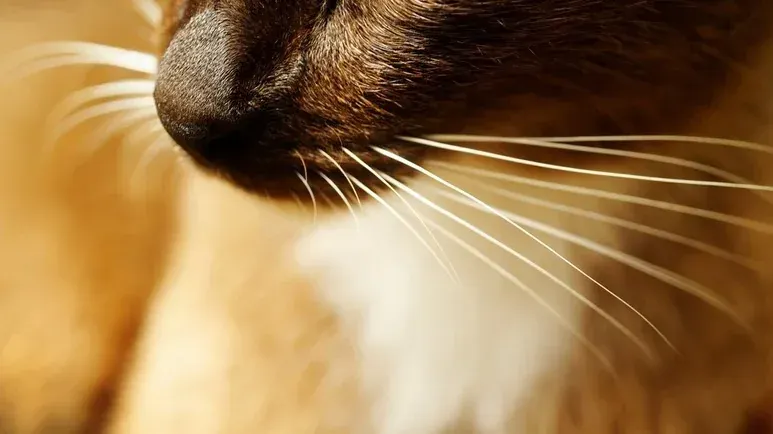
A cat's whiskers, also called vibrissae, are nothing like the fur on the rest of their body. Each whisker is rooted about three times deeper than a regular hair and is surrounded by blood vessels and dense clusters of sensory nerves. Veterinary sources describe them as roughly as sensitive as a human fingertip. They constantly feed information to the brain about air currents, nearby objects, and spatial boundaries, which is a big part of how cats navigate confidently in low light, judge whether they can fit through a gap, and track prey.1,2
That extraordinary sensitivity is a feature, not a flaw. It just happens to turn into a problem at the food bowl. Every time your cat dips their face into a deep, narrow dish, their whiskers brush the sides and send a steady stream of sensory signals to the brain. Repeated meal after meal, that steady stimulation can tip over into something like sensory overload. Oklahoma State University veterinarians describe it plainly: Whiskers sensitive enough to detect a faint breeze can become "easily fatigued by unnecessary contact, such as touching the sides of food or water bowls."3
The Signs at the Bowl
Because your cat can't tell you their whiskers feel overworked, the clues show up as behavior around mealtime. Look for:4,5
- Pawing kibble out of the bowl and onto the floor before eating it
- Pacing back and forth near the food area without diving in
- Eating a few bites, backing away, and returning later to try again
- Appearing hungry at the bowl but reluctant to actually eat from it
- Preferring to eat off a plate, placemat, or the floor instead of a deep dish
- Leaving food around the edges and eating only from the center
- Seeming unusually jumpy or stressed specifically at mealtime
- Splashing water out of the bowl or preferring to drink from taps and faucets
However, keep in mind that none of these signs are exclusive to whisker fatigue. A cat who suddenly avoids the bowl may also be dealing with dental pain, nausea, or another medical issue, so it's worth ruling those out, especially if the change is new or paired with weight loss. But if your cat has always batted food onto the placemat and is otherwise bright, active, and maintaining a healthy weight, bowl shape is a very reasonable place to start.
Why Bowl Shape Matters So Much
Most standard cat bowls are small, deep, and curved inward, which is exactly the shape that forces whiskers into contact with the walls on every single bite. The deeper and narrower the bowl, the more a cat has to push their face down and in to reach the food, and the more their whiskers brush the sides along the way. A nearly empty bowl is even worse; your cat has to reach down into a confined well to get the last pieces.
A wide, shallow dish solves the geometry directly. When the bowl is wider than a cat's whisker span and shallow enough that the face doesn't need to dip below the rim, whiskers stay clear of the sides for most of the meal. That's why VCA Animal Hospitals specifically recommends "food and water dishes with a flatter design so the cat's whiskers don't touch the sides" as a first step for cats showing signs of whisker fatigue.6
What to Look for in a Whisker-Friendly Bowl
You don't need a fancy specialty product. A regular saucer or shallow plate from your own kitchen often works. If you want something made for the purpose, prioritize these features over looks:
- Width over depth — The dish should be noticeably wider than it is deep, with a flat or very gently sloped base.
- Low, flared sides — Straight walls that rise sharply from the base are the main culprit. Low, outward-flared edges keep whiskers out of the way.
- Stable, non-slip base — A shallow bowl can slide around on hard floors, so a weighted base or non-slip pads help.
- Easy-to-clean material — Stainless steel and ceramic resist bacterial buildup better than plastic and won't develop scratches that trap odor over time.
Don't Forget the Water Bowl
The same sensory issue affects drinking. A cat who seems to under-drink, splashes water out of the dish, or prefers the bathroom faucet to their own bowl may be dealing with whisker contact at the water station too.
A wide, shallow water dish helps. So does a pet fountain with a broad basin. Many cats also prefer running water, and the flowing version solves two problems at once. Encouraging better hydration matters especially for senior cats and those with any history of kidney or urinary tract issues.7,8
Cats More Likely to Notice
Any cat can develop whisker fatigue, but a few groups tend to show it more. Flat-faced breeds like Persians and Himalayans already have less room to maneuver around a bowl rim, so bowl depth matters even more for them. Cats with especially long or prominent whiskers (Maine Coons, for example) brush against bowl sides more easily just because of the sheer width of their whisker span.
Senior cats, who may already be dealing with reduced mobility or dental sensitivity, tend to avoid a bowl that causes extra discomfort; a flatter dish is worth trying as part of any broader senior feeding routine. Multi-cat households benefit too, since individual shallow dishes reduce the crowding that makes whisker contact worse for every cat at the table.
A Few Things to Try This Week
You don't need to overhaul your cat's routine to test whether whisker fatigue is actually the issue. Start small and watch what changes. Here's where to start:
- Swap the current bowl for a wide, shallow plate or saucer for a few days and watch mealtime behavior.
- Fill the dish less full. A shallower pile in a deep bowl still forces whiskers against the walls as the meal goes on.
- Do the same for the water bowl. Try a wider dish or a pet fountain with a broad basin.
- Give it three to five days rather than expecting an overnight change. Cats sometimes need a little time to trust that the new bowl won't run out early.
- During the transition, you can offer food in both the old and new bowls, gradually phasing out the old one.
Never, Ever Do This to Your Cat's Whiskers
Remember: Don't ever trim your cat's whiskers to "fix" the problem. Whiskers are essential sensory organs, not just facial decoration. Cutting them can leave a cat genuinely disoriented and anxious, unable to accurately judge spaces or navigate confidently. The bowl is the thing to change. The whiskers themselves do their job just fine as long as they're not being bombarded with unnecessary contact.
When It's Not the Bowl
If switching dishes doesn't resolve the pacing, reluctance, or food-batting within a week or two, it's time for a veterinary visit rather than another bowl swap. Any of the following signs alongside eating changes also warrant professional attention sooner rather than later:9
- Sudden weight loss
- Vomiting or diarrhea with the appetite change
- Lethargy or a noticeable drop in energy
- Drooling, pawing at the mouth, or trouble chewing
- A complete refusal to eat for more than 24 hours
Giving Those Whiskers a Break
A pacing, bowl-batting cat isn't necessarily a dramatic one. More often than we realize, it just means the dish in front of them wasn't designed with whiskers in mind. Switching to a wide, shallow bowl is one of the lowest-cost, lowest-effort changes you can make for your cat, and for many, the pacing stops within days.
Your cat's whiskers really do have an opinion about that bowl. Giving them a little room to work the way they were built to work turns out to be one of those small, specific kindnesses that cat parents can offer without buying a thing — just a flatter plate from the cupboard and a few days of watching to see what changes.
Sources and References

Better Health Begins in the Bowl

Better Health Begins in the Bowl
The Ultimate Pet Nutrition Guide was created to help dog and cat parents understand what truly supports lifelong health.
In this free guide, you’ll discover:
-

How your pet’s biology influences their nutritional needs
-
Why conventional feeding advice often falls short
-
Practical ways to choose better food for your dog or cat
View our Privacy Policy and Terms of Service.