What Are Those Funny Little Bumps Trying to Tell You?
You notice a small, cauliflower-textured bump on your dog's chin that was not there last week. Before you spiral into worry, consider this — those funny little growths might be one of the more encouraging signals a canine immune system can send.
Reviewed by Dr. Tracy Duffner


Join the Bark & Whiskers™ Family
Sign up today for our FREE newsletter, packed with expert advice and insider tips to keep your beloved pet in tip-top shape.
View our Privacy Policy and Terms of Service.


STORY AT-A-GLANCE
- Dog warts are benign growths that can be caused by canine papillomavirus (CPV), with 24 different types now identified — most affecting either the skin or the mouth, and most resolving on their own without any medical intervention
- Puppies and adolescent dogs are most commonly affected because their immune systems are still learning to recognize new viruses, while senior dogs may develop slower-growing skin warts as immune function naturally declines with age and with hormone changes
- The classic papilloma-type dog wart has a rough cauliflower texture, appears in clusters or singly around the mouth, eyes, face, paws, or ears, and usually resolves within four to eight weeks for oral warts and about three months for skin warts
- Canine papillomavirus is species-specific — dogs cannot pass it to cats, other pets, or humans, and the virus typically enters through tiny skin breaks or moist areas like the mouth
- Integrative and holistic veterinarians focus on supporting the immune system with real-food diets, gut health, immune-supportive nutrients, medicinal mushrooms, stress reduction, and homeopathic remedies rather than jumping to invasive interventions
You are scratching your dog's chin one afternoon and your fingers find something new — a small, rough bump that was not there last week. It looks a little like a tiny cauliflower, and it does not seem to bother them. You check for more, and see another one on their lip, and a third on their paw — so what are these unusual growths?
There is a good chance you are looking at a viral wart. And while any new lump on your dog deserves attention, the good news is that most of these particular bumps are far more of a cosmetic issue than a medical crisis. They are actually your dog's immune system sending a signal — and once you understand what they are, they become much less alarming.
What These Bumps Actually Are
Viral dog warts are benign growths caused by canine papillomavirus (CPV). Researchers have now identified 24 different types of canine papillomavirus, most of which affect either the skin or the mouth. Cats have their own version, feline papillomavirus, with six types identified so far. Both species carry papillomaviruses commonly, though visible warts are far more frequent in dogs than cats.1
The virus works by entering skin cells through tiny breaks — a small cut from rough play, a scratch from grass, a naturally moist area like the mouth — and hijacking normal cell growth to create the characteristic bumpy texture we recognize as a wart. The immune system then gradually recognizes the invader and mounts a response, which is what eventually clears the wart.2
Who Gets Them and Why
Cutaneous warts are actually the second most frequent skin tumor in dogs under one year of age. Puppies and adolescent dogs are the classic patients because their immune systems are still learning to recognize new viruses, and their tendency to mouth and chew everything in sight gives the virus plenty of entry points. Oral warts in particular tend to show up in dogs under about 18 months.3
Older dogs — usually over about seven years — also develop warts, though a different flavor of them. These warts tend to show up on the body and tend to not be papillomavirus related; they are generally sebaceous adenomas, benign growths stemming out of the sebaceous gland. Their warts tend to be slower-growing skin warts rather than the classic oral clusters, and they show up as pet's experience age-related changes in skin barrier health, hormone balance, and immune function.
Certain breeds may be more susceptible to papillomavirus based on various meta-analyses of case reports and geographic studies: Pugs and Miniature Schnauzers are known to be predisposed to the viral cutaneous plaque form of papillomavirus, and case reports of this in Vizslas have emerged. Other breeds including again Miniature Schnauzers and Labrador retrievers have been reported to be predisposed to the papillomatous form of the disease.
Anything that suppresses immune function — chronic stress, poor diet, illness, being on immunosuppressive medication — makes any dog more vulnerable regardless of breed. And in females, hormonal changes such as coming into heat for the first time can also lower immune resilience temporarily.4
What They Look Like
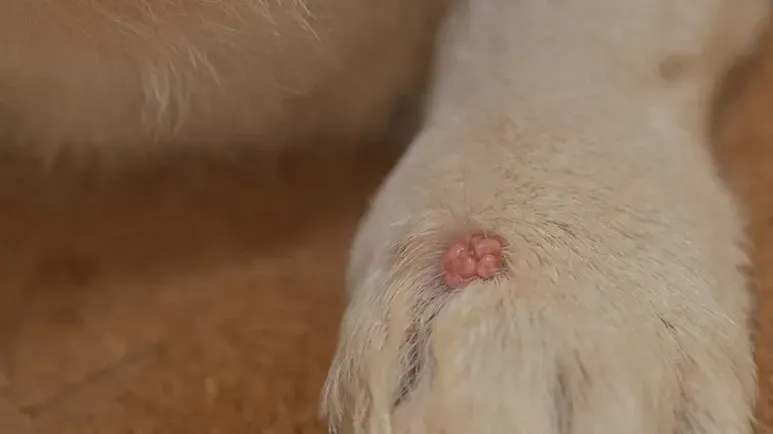
The classic dog wart has a rough, cauliflower-like texture that feels firm to the touch. They can appear as single growths or in clusters, and they range from the size of a grain of rice to the size of a small grape. Some look feathery or scaly, and the color usually matches your dog's skin — flesh-toned, pink, or slightly darker. Common places to find them include:
- Mouth, lips, and gums (especially in puppies)
- Around the eyes and eyelids
- On the face and muzzle
- Ears and ear flaps
- Between the toes and on paw pads
- Occasionally on the genital area
Fresh warts often appear pink or flesh-colored. Older ones may darken or develop a crusty surface as the immune system begins fighting back. Warts on the mouth deserve a little extra attention since they can sometimes interfere with eating in severe cases, but this is uncommon.5
How They Spread
The virus spreads through direct contact — saliva, shared toys, food and water bowls, bedding — with an infected dog or with a dog who is carrying the virus without symptoms. Inoculation of the virus requires a microtear or injury in the skin surface for the virus to transfer. The incubation period is typically four to six weeks, which means a wart you are spotting today came from an exposure over a month ago. That timeline is actually reassuring: the situation is not an immediate emergency, and your dog's immune system has already been working on it for weeks.
The species boundary is important to know. Canine papillomavirus affects only dogs. Your cats, your family members, and other pets in the household are not at risk of catching it from your dog. Feline papillomavirus works the same way — cats cannot give it to dogs, and neither species passes it to humans.6,7
The Reassuring Part
Most canine cutaneous warts regress spontaneously within about three months, and most oral warts resolve within four to eight weeks. From an integrative and holistic veterinary perspective, the appearance of warts is often best understood as a sign that your dog's immune system is actively engaging with and building resistance to the virus — much the way children develop resistance to common viruses as they grow. Progression from a benign wart to something more serious like a squamous cell carcinoma is extremely rare, and typically only happens in dogs with significant immune suppression.8,9
Warts may actually appear to worsen slightly before improvement begins — this represents immune activation, not treatment failure. During the first couple of weeks you may see little visible change. Significant improvement usually shows up during weeks 5 through 7, with complete resolution by around week 8 in most straightforward cases.
Supporting Your Dog's Immune Response
Since a strong immune system is what actually clears the virus, the most useful thing you can do is support that system. Integrative and holistic veterinarians commonly focus on:10
- Species-appropriate diet — High-quality, minimally processed, real-food feeding — with plenty of clean protein, healthy fats, and appropriate carbohydrates — provides the raw materials your dog's immune system uses to build defenses. Fresh food matters more than most pet parents realize when it comes to immune resilience.
- Gut health support — A significant portion of the immune system lives in the gut. A good-quality probiotic and prebiotic combination, along with digestive enzymes if needed, can help keep the immune foundation strong.
- Immune-supportive nutrients — Vitamin C, vitamin D at appropriate levels, EPA and DHA, and chlorella are all commonly used in holistic protocols. A methyl donor like DMG (dimethylglycine) or SAMe is sometimes added. Talk to an integrative vet about supplements and doses appropriate for your specific dog.
- Medicinal mushrooms — Extracts like maitake D-fraction, reishi, and turkey tail are widely used to support immune modulation in dogs. Look for veterinary-grade formulations rather than human supplements.
- Stress reduction — Emotional, physical, and environmental stressors all suppress immune function. A calm household routine, plenty of rest, appropriate exercise, and time outdoors all matter. Even minor adjustments — reducing loud noises during recovery, keeping feeding schedules predictable — can help.
- Homeopathic support — Many holistic veterinarians reach for constitutional homeopathic remedies matched to the specific dog's overall symptom picture, rather than a generic wart remedy. Working with a veterinary homeopath can produce genuinely impressive results for some dogs.
Home Care While You Wait
A few practical things can help while the immune system does its work. None of them will make the warts vanish overnight, but they do prevent the small problems that can turn a straightforward viral wart into a bigger issue:
- Discourage licking, chewing, or scratching at wart sites — the trauma can introduce bacteria and slow healing
- Do a gentle daily check for changes in size, color, or new growths
- Clean any discharge around a wart site gently with warm water
- Consider weekly photos in similar lighting to track real progress objectively
- Separate food and water bowls, toys, and bedding from other dogs in the household during the active wart phase
- Continue normal exercise, play, and socialization — strict isolation is not necessary or helpful
- If your dog is a persistent licker, a soft recovery collar worn briefly during unsupervised time prevents wart trauma without adding stress
When to Call the Vet
Most warts do not need medical intervention. But there are situations that warrant a professional look, such as:
- A bump that is smooth and dome-shaped, unusually hard or soft, or growing rapidly over days rather than weeks
- Signs of pain when the area is touched
- Bleeding, discharge, warmth, or swelling around the growth
- Warts that interfere with eating, drinking, or breathing
- Warts that persist well beyond the typical eight-to-twelve-week window without any sign of improvement
- Any lump you are not confident is a wart — sebaceous cysts, mast cell tumors, and other skin conditions can look similar and require different management
In dogs with severe cases — usually those on immunosuppressive medication or with widespread oral warts that are interfering with eating — veterinarians occasionally use specific interventions to speed resolution. But for the vast majority of otherwise healthy dogs, patience plus immune support does the job.
What the Bumps Are Really Saying
Those funny little cauliflower bumps are not nothing. They are a signal that your dog encountered a virus, and their immune system is now doing exactly what it is supposed to do. In most cases, they will come, they will persist for a few weeks, and they will disappear again with the immune system slightly stronger and better educated than it was before. Support the immune system with real food, a low-stress environment, and thoughtful integrative care, and the whole process usually resolves quietly on its own.
Keep an eye on them, take a picture now and then to track progress, and check in with your veterinarian — ideally one with an integrative or holistic bent — if anything looks off. But mostly, take a deep breath. Your dog is doing exactly what their body was built to do. Sometimes, the funny little bumps are just proof that everything is working.
Sources and References

Better Health Begins in the Bowl
Better Health Begins in the Bowl
The Ultimate Pet Nutrition Guide was created to help dog and cat parents understand what truly supports lifelong health.
In this free guide, you’ll discover:
-

How your pet’s biology influences their nutritional needs
-
Why conventional feeding advice often falls short
-
Practical ways to choose better food for your dog or cat
View our Privacy Policy and Terms of Service.