When the Paw Licking Just Won't Quit
That quiet slurping sound from the corner of the living room isn't just a habit. It's your dog's way of telling you something is wrong between their toes, and the fix often starts with a shallow basin and a few thoughtfully chosen ingredients.
Reviewed by Dr. Arielle Walton

Join the Bark & Whiskers™ Family
Sign up today for our FREE newsletter, packed with expert advice and insider tips to keep your beloved pet in tip-top shape.
View our Privacy Policy and Terms of Service.


STORY AT-A-GLANCE
- The warm, moist, poorly ventilated spaces between a dog's toes are a natural haven for Malassezia yeast and Staphylococcus bacteria, both of which live harmlessly on skin until conditions let them multiply
- Chronic paw licking usually signals allergies, not the main problem. Inflammation disrupts the skin barrier, and constant licking then macerates the tissue further, driving a self-perpetuating cycle
- Paw soak options range from gentle to strong: plain water rinses, cooled herbal teas, apple cider vinegar with green or chamomile tea, diluted white vinegar, povidone-iodine, and chlorhexidine for confirmed mixed infections
- Thorough drying after every soak is non-negotiable. Moisture trapped between the toes feeds the exact organisms you're trying to eliminate, so a good towel and even a cool blow dryer are essential
- Real resolution comes from addressing the root cause: a clean, species-appropriate diet, gut support, environmental awareness, and working with an integrative vet on the deeper allergy or immune story driving recurrent flare-ups
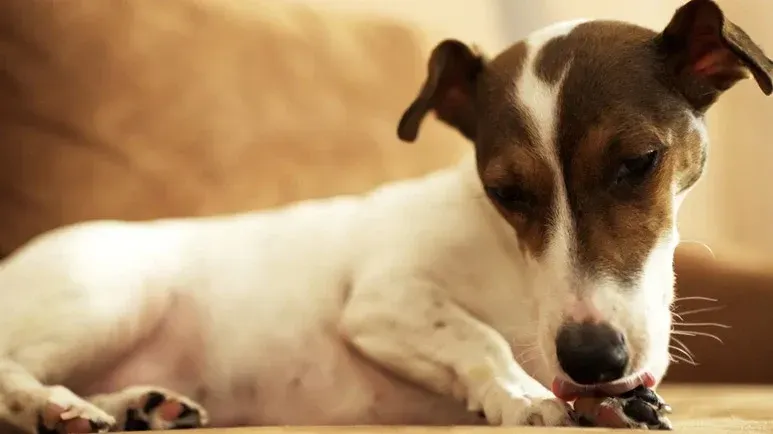
It usually starts as a quiet, little slurping sound in the background. You look over, and there's your dog, hunched over one paw, going at it like they're trying to shine a shoe. You call their name, and they stop for a second, but as soon as you look away, they start again.
If you've noticed your dog licking, chewing, or biting at their paws, sometimes so obsessively that it keeps you awake at night, there's a very good chance something is going on between those toes that they can't tell you about. Thankfully, gentle at-home approaches can provide real relief while you and your vet address the underlying cause.
Why Paws Are a Perfect Storm
The spaces between a dog's toes are warm, dark, poorly ventilated, and constantly picking up moisture from walking on grass, sidewalks, puddles, snow, wet lawns, and floors your dog has just wandered across. That microenvironment is basically a petri dish. Two organisms in particular love these conditions: the Malassezia pachydermatis yeast and the Staphylococcus pseudintermedius bacteria.
Both naturally live on dog skin, and in small numbers, they're harmless. But give them warmth, moisture, and a disrupted skin barrier, and they multiply fast.1 Dogs with tight interdigital webbing, hairy feet, or heavy skin folds around the paws are especially vulnerable. So are dogs who swim, run through wet grass, or come home from walks with damp feet that never quite dry out.
The Underlying Cause Most Owners Miss
Most integrative and holistic veterinarians believe paw yeast and bacterial infections are almost always symptoms of something else. The most common something else is allergies. When a dog with atopic dermatitis or food sensitivity walks on grass, carpet, or any allergen-laden surface, the immune system fires off an inflammatory response in the paw skin. That inflammation disrupts the natural skin barrier, changes local pH, and shifts the composition of the skin's protective secretions — all of which create conditions where yeast and bacteria flourish.2,3
Licking makes it worse: Saliva deposits moisture and digestive enzymes on the skin, further macerating the tissue and cranking up the humidity between the toes. Damp, damaged skin is even more hospitable to microbes. More microbes mean more itching, and more itching means more licking — the cycle continues.
From a holistic perspective, chasing the surface infection with soak after soak without addressing what drives the inflammation keeps you in the loop indefinitely. The soaks matter. But so does the root cause.
Signs to Watch For
Early recognition means earlier intervention. The tricky part is that paw problems often start subtly and only get labeled a "problem" when they're impossible to ignore — so learning the earliest hints buys you time to intervene before things escalate. Common signs of a paw yeast or bacterial issue include:4
- Obsessive licking, chewing, or biting at the paws
- A distinctive musty, corn-chip, or yeasty smell coming from the feet
- Reddish-brown saliva staining on light-colored fur between the toes
- Redness, swelling, or puffiness in the interdigital spaces
- Greasy, waxy, or crusty debris around the paw pads and nail beds
- Limping or reluctance to walk on hard surfaces
- Thickened, darkened, elephant-skin texture in chronic cases
- Frequent ear issues alongside the paw problem; a classic clue that allergies are in the mix
Which Dogs Get Hit Hardest
Some breeds are just built for this problem. If your dog is one of these, a proactive paw care routine is worth building into daily life:
- English Bulldogs — They have broad, flat paws, tight interdigital spaces, and heavy skin folds that trap moisture.
- Labrador Retrievers — One of the most allergy-prone breeds, plus they love water, which keeps their paws damp.
- Cocker Spaniels — Their heavily feathered paws hold moisture against the skin.
- West Highland White Terriers — They have a high rate of atopic dermatitis, and their white fur shows every stain.
- Basset Hounds — They have large, heavy paws, deep interdigital folds, and low-slung bodies that keep feet close to damp ground.
However, keep in mind that any dog with allergies, even breeds not on this list, can still get stuck in the same cycle.
Paw Soak Options: From Gentle to Strong
Paw soaks are one of the most effective at-home tools for interdigital problems because they deliver treatment directly into the spaces sprays and wipes can't reach. Here are the options integrative and holistic veterinarians most often reach for, from the gentlest to the strongest:5,6,7
- Plain lukewarm water — A quick rinse or soak after every walk removes pollen, grass residue, dust, and other environmental material before it can trigger inflammation. This is a great daily habit even for dogs without an active problem.
- Cooled green or chamomile tea — A gentle traditional rinse that many integrative practitioners like for mildly irritated paws. Green tea is rich in antioxidants and supports skin health, while chamomile is soothing and calming. Brew strong, cool completely, and use on intact skin. Skip if any irritation worsens.
- Salt water — Make a simple homemade soak by dissolving 1 level teaspoon of table salt in 1 cup of previously boiled, cooled water. It helps cleanse and soothe mildly irritated but intact skin. Skip if there's cracking or raw skin, as salt stings. Never use seawater, which can contain contaminants.
- Epsom salt — Dissolve 1 tablespoon of Epsom salt (magnesium sulfate) in a quart of warm water. It's not directly antimicrobial, but the osmotic action reduces swelling and softens crusty debris. It works well as a soothing standalone soak or as a pre-treatment before a stronger antimicrobial soak. Soak for five to 10 minutes.
- Apple cider vinegar and herbal tea — Mix 4 cups warm water with 1 to 2 tablespoons raw, unfiltered apple cider vinegar (with the mother) and 1 cup strongly brewed, cooled green or chamomile tea. It works best for itchy, yeast-prone, or allergy-affected paws.
Soak for three to five minutes, then pat dry thoroughly without rinsing. Some conventional vets prefer distilled white vinegar over ACV, arguing that the organic compounds in cider vinegar could feed yeast. Both camps have their reasoning. Watch how your dog's paws respond and follow what works. - Diluted white vinegar — Mix one part distilled white vinegar with two to four parts water for a mildly acidic soak (pH around 3 to 4) that inhibits yeast growth. Malassezia yeast thrives in alkaline environments, so acidifying the skin surface disrupts its growth cycle. This is ideal for mild yeast overgrowth or as a maintenance soak. However, never use it on broken or raw skin — the acidity will sting. Soak for five minutes, then pat dry.
- Povidone-iodine (Betadine) — Both conventional and holistic veterinarians widely recommend this for more inflamed or infected paws. Add just enough povidone-iodine to warm water so the solution turns the color of weak iced tea or light amber. Soak for 2 to 5 minutes and pat dry; no rinsing needed. Iodine has strong antifungal and antibacterial action.
However, do not use this daily long-term, on deep wounds, extensively broken skin, or on dogs with known iodine sensitivity. It can also temporarily stain light fur, which is cosmetic and harmless. - Chlorhexidine — This is the strongest of the commonly used soaks. Dilute a 2% chlorhexidine gluconate stock solution to a 0.05% working strength (about 1 ounce per 40 ounces of lukewarm water) until the solution turns pale blue-green. This broad-spectrum works against both yeast and bacteria, with residual binding activity that keeps working for hours after the soak.
Soak for five to 10 minutes and don't rinse; the residual layer is part of the benefit. It works best for confirmed mixed yeast and bacterial infections, ideally guided by a veterinary cytology sample.
How to Actually Do a Paw Soak
The setup is simpler than it sounds. Most pet parents picture something elaborate and end up putting it off entirely, but a paw soak is really just a shallow container of the right solution, a few minutes of your dog's cooperation, and a good towel at the end. Here's the basic flow:
- Choose your container: a shallow basin for small dogs, a shower tray or bathtub for larger dogs, or a bucket if that's what you have.
- Fill it with enough solution to cover the paw pads and interdigital spaces (usually 2 to 3 inches deep).
- Use lukewarm water, never hot.
- Place the paw in and gently spread the toes so the solution reaches every crevice.
- Follow the recommended time for whichever soak you're using.
- Pat completely dry with a clean towel, spreading the toes to blot the webbing.
- For heavy paw fur, a cool-setting hair dryer held 12 inches away helps ensure complete drying.
Take note that the drying step is not optional. Moisture trapped between the toes after a soak feeds exactly the organisms you're trying to eliminate. Skipping this step can actually make things worse.
If your dog resists sitting in a basin, try a lick mat spread with a little peanut butter (xylitol-free) at nose height to distract them. Some pet parents soak one paw at a time in a smaller container while the dog lies on their side. A large zip-lock bag held around the ankle also works in a pinch.
Frequency depends on what you're treating. Mild seasonal irritation might need a soak or rinse one to three times a week. An active infection might need daily soaks for one to two weeks, then every other day for two weeks, then a maintenance rhythm of two to three times a week. Work with your vet to dial it in.
Beyond the Soak, Address the Real Problem
Paw soaks treat the surface, but real resolution requires looking at what's driving the inflammation and infection in the first place. From an integrative and holistic point of view, the questions worth asking include:
- What's going into the bowl? Food is often the biggest overlooked factor in chronic skin problems. Grains, starches, additives, preservatives, and highly processed ingredients can all contribute to inflammation and immune irritation. Many holistic vets start with a clean, species-appropriate whole-food diet and careful attention to every treat, chew, supplement, and flavored medication. Sometimes progress begins with what you take out, not what you add.
- How's the gut? Gut health has an outsized influence on skin. A disrupted microbiome shows up in the skin barrier, in inflammation levels, and in how well the immune system tolerates environmental triggers. Supporting the gut is often the missing link in stubborn skin cases.
- What's the environment doing? Grasses, pollen, dust mites, mold, damp conditions, new carpets, floor cleaners, fragranced household products, lawn treatments, and glyphosate-sprayed grass can all contribute. You can't eliminate every trigger, but noticing patterns like whether it's worse after certain walks, in certain seasons, or after certain products go on the floor can give you real leverage.
- What's the daily maintenance? Simple habits change outcomes, such as:
- • Keeping a designated paw towel by every door and wiping paws after every outing
- • Trimming the fur between paw pads and toes so the skin can breathe and dry
- • Washing and drying pet bedding weekly to reduce allergen buildup
- • Rinsing paws after walks in areas with lawn chemicals or heavy pollen
- • Considering a paw balm or plain aloe vera product for dry intact skin
When to Call the Vet
Home care has real value, but some situations need veterinary attention. Skip the soak and get to the vet if:
- Paws are painful, hot, or causing limping
- There's significant swelling, cracking, ulceration, or bleeding
- Discharge or strong odor is present
- You see lumps or deep lesions
- Symptoms are worsening despite home care
A cytology sample, where your vet takes a quick tape impression or swab from the interdigital skin and looks at it under a microscope, is one of the most useful tests available. It tells you whether you're dealing with yeast, bacteria, or both, and helps guide which soak makes sense for your specific situation. If soaks and standard treatments aren't working, a bacterial culture and sensitivity test can identify resistant strains like methicillin-resistant Staphylococcus pseudintermedius (MRSP), which is increasingly common and requires targeted therapy.8
If paw infections keep coming back, an allergy workup, including allergy testing, elimination diet trials, or a broader integrative assessment, is worth the investment. Managing the root cause is what breaks the cycle for good.
The Real Takeaway
A dog who won't stop licking their paws is trying to tell you something. Sometimes it's a mild seasonal irritation that a simple rinse will fix. Sometimes it's yeast, bacteria, or both, thriving in the humid space between their toes. And sometimes, it's the visible tip of a bigger allergy or dietary story that will keep resurfacing until you address it at the source.
The good news is that there's a whole ladder of at-home options that can bring meaningful relief. Layer that with thoughtful attention to diet, gut health, and environmental triggers, and with a good integrative or holistic veterinarian in your corner, most dogs can go from perpetual paw-lickers to quiet, comfortable companions again.
Sources and References

Better Health Begins in the Bowl

Better Health Begins in the Bowl
The Ultimate Pet Nutrition Guide was created to help dog and cat parents understand what truly supports lifelong health.
In this free guide, you’ll discover:
-

How your pet’s biology influences their nutritional needs
-
Why conventional feeding advice often falls short
-
Practical ways to choose better food for your dog or cat
View our Privacy Policy and Terms of Service.