Does Your Pet Panic During Storms?
If your usually cheerful pup starts trembling whenever a storm rolls in, there might be more to it than fear of loud noises. Learn what drives storm anxiety, how to recognize the warning signs, and how to help them feel safer.
Reviewed by Dr. Tracy Duffner




Join the Bark & Whiskers™ Family
Sign up today for our FREE newsletter, packed with expert advice and insider tips to keep your beloved pet in tip-top shape.
View our Privacy Policy and Terms of Service.


STORY AT-A-GLANCE
- An estimated 25% to 50% of dogs experience noise anxiety, and thunderstorms are among the most common triggers. Storm phobia can worsen over time if it is left unaddressed
- Storms frighten dogs for more than the noise alone; sensitivity to shifting air pressure and even static building up in a dog's coat can all play a part
- Watch for obvious signs of anxiety, such as pacing, panting, trembling, or drooling, as well as subtler cues like lip-licking, yawning, tucked tail, and pinned-back ears
- Giving your dog a safe den-like space, blocking out lightning and thunder, offering a calming activity, providing reassurance, and behavior modification training can help them get through a storm
- A sudden new fear of storms in a dog that was never bothered before should be discussed with a veterinarian, as it can signal pain, heart disease, or a neurological problem
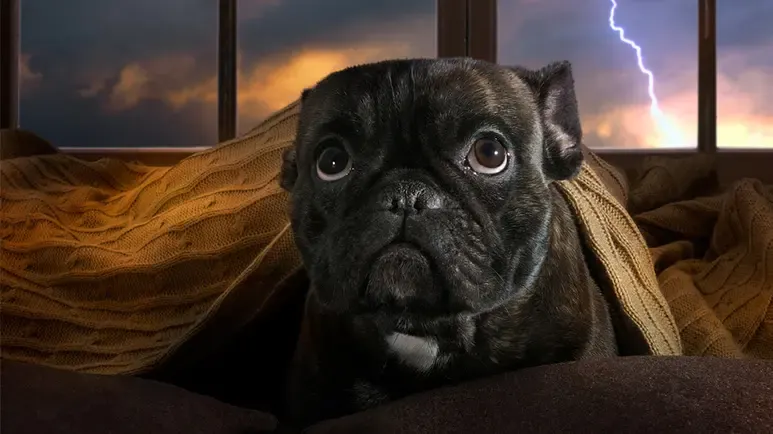
Why do thunderstorms send so many dogs into a panic? The loud thunder is only part of the reason. If your dog trembles and hides every time a storm rolls in, what you are seeing is a genuine fear response rather than an overreaction.
Storm phobia is recognized as a behavioral disorder that combines physical, emotional, and behavioral reactions.1 Understanding what is driving it can help you respond better as a pet parent.
Why Thunder Turns Your Dog Into a Nervous Wreck
An estimated 25% to 50% of all dogs experience some form of noise anxiety,2 and thunder is a common trigger. In an article published by the American Kennel Club (AKC), certified trainer Trista Miller explains that dogs hear thunder well before we do.
Their hearing is far more sensitive than ours, and fear of loud noise is baked into them as a survival instinct.3 Dogs may also detect changes in air pressure, allowing them to sense an approaching storm before the first drop of rain hits your window.
There is another factor you might not expect: static electricity. A feature in Vets of the Rockies cited that thunderstorms charge the surrounding air, and that electrical charge can build up in your dog's coat, especially if they are a larger breed or have a thick double coat.4 When their nose touches metal, like a doorknob or a food bowl, they may feel a small shock.
This invisible discomfort may explain why your dog beelines for the bathroom or basement during a storm. Plumbing and porcelain fixtures may help dissipate static electricity, making a bathtub or tiled room feel safer than other areas of the house.5 Without proper support, storm anxiety tends to get worse with every passing storm season and can take a toll on both your dog's health and quality of life.6
Early Signs Your Dog Is Anxious
Dogs often show subtle signs of anxiety before more obvious behaviors start, such as pacing, trembling, or drooling. University of Florida College of Veterinary Medicine clinical behaviorist Terry Curtis notes that early stress signals may include:7
- Yawning — A big, sudden yawn that has nothing to do with being tired is one of the clearest early signs that your dog is feeling uneasy or overwhelmed, particularly when it occurs alongside other changes in body language, and it is easy to miss if you are not looking.
- Frequent lip-licking and widened eyes — Repeatedly licking their lips paired with wide, alert eyes may indicate that your dog has noticed something unsettling in their environment.
- Pinned-back ears and a tucked tail — Ears held flat against the head and a tucked or lowered tail often signal fear, nervousness, or an attempt to make the body appear smaller.
Catching these cues early gives you a chance to step in before your dog's anxiety escalates. If you notice them before the storm arrives, guide your dog to a quiet, familiar space where they can feel more secure.
It Is Not Always Storm Anxiety
If your dog suddenly becomes fearful during thunderstorms, even though it never seemed to bother them before, do not assume it is simply a new fear they have developed.8 A new sensitivity to storms may sometimes be linked to pain, heart problems, and neurological conditions. If your dog's reaction to storms seems to come out of nowhere, it is a good idea to talk with your veterinarian to rule out any underlying health issues.
Storm anxiety also rarely exists as a sole anxiety. Dogs with storm phobias often have other noise sensitivities and frequently also have separation anxiety.9,10 Also, scientists have found a link between level of exercise dogs receives daily and both noise and separation anxiety behaviors.11 Dogs receiving more daily exercise exhibited less anxiety behaviors. If your pet is dealing with storm phobias, talk to your veterinarian about your pet’s sensitivities and behavior, and see if adjusting your pet’s exercise program could be helpful.
Storm anxiety does not just affect your dog's emotions. Repeated episodes of fear and stress can increase their heart rate, raise stress hormones, disrupt digestion, and even put them at risk of injury.12 Some dogs become so distressed during storms that they damage their teeth or injure themselves while trying to escape.
Storms can occasionally pose a direct physical danger as well. Although lightning strikes are rare, they require immediate emergency care. If your dog has been struck, take them to an emergency veterinarian immediately, even if they seem normal at first, because serious internal injuries may not be immediately visible.13
Help Your Pet Feel Safe During a Storm
The good news is that storm anxiety is manageable, even when it does not disappear completely. For many dogs, a combination of calming strategies and small changes to their environment usually beats any single fix on its own.
- Create a comfortable, safe space — Dogs tend to gravitate toward den-like spots, such as a crate, closet, or bathroom, because enclosed spaces feel safer. Make the space comfortable and cozy with a soft bed, familiar blankets, and their favorite toys. Let your dog choose whether to stay there rather than forcing them inside.14 And as we talked about above, if your dog feels safest in the bathroom, give them access. Being near plumbing is very grounding for them.
- Muffle storm sounds and flashes — Close your curtains or blinds to block out flashes of lightning, turn on indoor lights, and use a TV, radio, fan, or white noise machine to reduce the sound of thunder.15 The AKC adds that classical music tends to have a soothing effect on dogs.16,17
- Keep their mouth busy — Chewing and licking are naturally calming activities for many dogs, so a lick mat smeared with peanut butter, a stuffed food toy, or a puzzle feeder can help keep them occupied and redirect nervous energy.18 Make sure any peanut butter you use is free of xylitol, which is toxic to dogs.
- Try an anxiety vest — Anxiety vests work by applying gentle, steady pressure around the body, which may help some dogs feel more secure. Introduce the vest well before a storm arrives so your dog has time to get used to wearing it.19
- Tire them out ahead of time — If a storm is in the forecast, try fitting in a brisk walk or active play session beforehand. A dog who has burned off excess energy may settle more easily once the weather turns.20
- Let your dog curl up to you — It is a common myth that comforting your dog during a storm reinforces their fear. Fear is an involuntary physical response, not a behavior your affection can accidentally encourage.21 It is okay to let them stay close, speak to them calmly, or gently pet them if that seems to help. Follow their lead, as some dogs prefer physical reassurance while others want space.
If your dog continues to tremble, hide, panic, or try to escape despite these measures, talk to your veterinarian. They can discuss additional treatment options and recommend behavior-modification techniques that gradually help your dog form calmer associations with storms.22
You cannot stop the rain and thunder from coming, but you can help your dog get through it. The better you understand your dog's triggers and needs, the better prepared you will be to help them feel safe when the next storm arrives.
Sources and References
- 1,8,12,19,21 PetMD, September 23, 2025
- 2 Veterinary Clinics of North America: Small Animal Practice Volume 38, Issue 5, September 2008, Pages 1081-1106
- 3 American Kennel Club, September 30, 2025
- 4,6,7,13,22 Vets of the Rockies, Why Are Dogs Afraid of Thunderstorms?
- 5 Whole Dog Journal, Why Your Dog Is Afraid of Thunder
- 9 Applied Animal Behaviour Science, August 2015
- 10 J Am Vet Med Assoc. 2001 Aug 15;219(4):467-73
- 11 PLoS One. 2015 Nov 3;10(11):e0141907
- 14,15,20 Animal Humane Society, Calm Your Pet’s Fear of Thunderstorms with These Simple Tips
- 16,18 American Kennel Club, Understanding Thunderstorm Anxiety in Dogs
- 17 Animals (Basel). 2021 Dec 16;11(12):3572, The Use of Music

Better Health Begins in the Bowl

Better Health Begins in the Bowl
The Ultimate Pet Nutrition Guide was created to help dog and cat parents understand what truly supports lifelong health.
In this free guide, you’ll discover:
-

How your pet’s biology influences their nutritional needs
-
Why conventional feeding advice often falls short
-
Practical ways to choose better food for your dog or cat
View our Privacy Policy and Terms of Service.