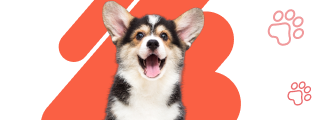
When Cute Turns Into Something Else
That tail chase before dinner, the paw-licking on the couch, the laser-pointer sprint across the living room — most of these moments are exactly what they look like, but a handful of them are quietly asking for help. Learning to spot the difference is one of the quieter ways of loving a dog well.
Reviewed by Dr. Elizabeth Hardoon

Join the Bark & Whiskers™ Family
Sign up today for our FREE newsletter, packed with expert advice and insider tips to keep your beloved pet in tip-top shape.
View our Privacy Policy and Terms of Service.


STORY AT-A-GLANCE
- Some of the "cutest" dog behaviors can be perfectly normal in small doses but occasionally cross a line into canine compulsive disorder, which may affect up to 2% to 3% of dogs
- Common compulsive behaviors to watch for include tail chasing and spinning, light and shadow chasing, lick granuloma from excessive paw licking, flank sucking, fly-snapping at imaginary flies, and pica
- Many other everyday behaviors are commonly misinterpreted: A submissive grin is an appeasement signal (not a smile), leaning can be spatial anxiety (not affection), and yawning during a hug is a stress signal
- Compulsive behaviors typically emerge in dogs between 6 and 12 months old and involve a mix of genetics, environmental stress, and neurochemistry
- The most effective home strategies are basic but powerful: Increase physical and mental exercise, reduce reinforcement of the behavior (even negative attention counts), reward calm, minimize stressors, and skip punishments
Your dog spins in tight circles chasing their tail before dinner, and everyone in the family laughs. The puppy who eagerly licks their paw earns coos. The dog who "smiles" with all their teeth when guests arrive is a family legend. The one who chases a laser pointer or a beam of sunlight across the floor could star in their own viral video.
These behaviors are undeniably cute in small doses. But some of the most photogenic quirks in a dog's repertoire can quietly cross a line from playful to problematic. Learning where that line is — and how to spot it early — is one of the biggest gifts you can give a dog.
Why We Misread Dog Behavior
A lot of the ways we interpret our dogs come from projecting human emotions onto them. That is understandable — they are family. But it can mean we miss what the behavior actually says.
Researchers and veterinary behaviorists have spent decades decoding canine communication. What they consistently find is that many gestures we read as affectionate or funny are actually stress signals, appeasement behaviors, or early expressions of a compulsive habit.1
It does not mean every quirky behavior is a red flag. It just means context matters, and so does frequency.
The Tail Chase: When Play Becomes a Loop
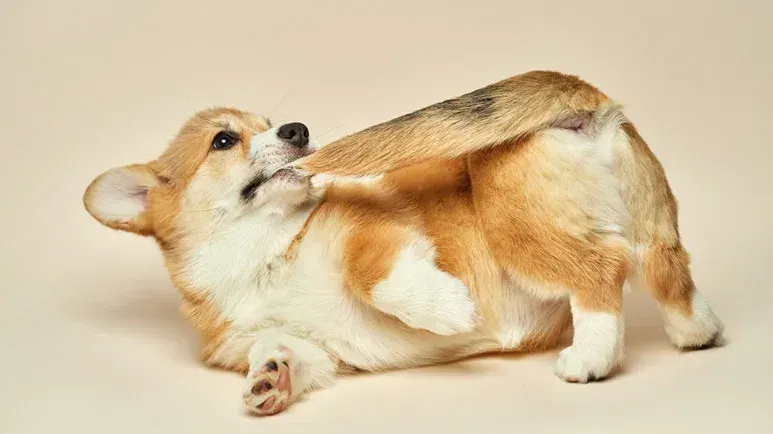
Tail chasing is one of the most common examples of a behavior that can go either way. Puppies discover their tails and chase them out of curiosity. Adult dogs occasionally spin during play or excitement, and it stops on its own once something else catches their eye. Both of these are perfectly normal.
What is not normal is a dog who spins in circles frequently, bites at the tail, seems unable to stop, or does it in response to stress rather than play. That version of tail chasing can indicate skin problems, fleas, allergies, anal gland trouble, spinal or hip pain, or a full-blown compulsive disorder.2
If your dog has always occasionally chased their tail during play, that is probably fine. If they suddenly start doing it out of nowhere, if the behavior is intensifying, or if it is causing hair loss, sores, or injuries, then it is time to have a conversation with your vet.
Spinning: The Cute Warm-Up That Sometimes Is Not
A brief spin before dinner or a walk is a classic dog moment. It looks like joy, and often it is. But when the spinning becomes hard to interrupt, happens frequently, or shows up outside of clearly exciting moments, it can indicate canine compulsive disorder.
Herding breeds are especially prone to compulsive spinning and tail chasing. It is most commonly seen in Corgis, Australian Shepherds, and Border Collies; but Bull Terriers and German Shepherds also have a higher genetic predisposition.
Owners who laugh at, film, or encourage spinning behavior can unintentionally reinforce it. That does not mean you caused the problem, but it does mean that stepping back from cheering it on is one of the first useful shifts to make.3,4,5
The Laser Pointer Trap
Chasing a beam of light is a beloved game in many households — for dogs and cats alike. But repeated laser pointer play can trigger something less amusing: light and shadow chasing that persists long after the laser has been put away.
Dogs prone to this compulsion may start staring at, barking at, or chasing reflections off jewelry, sunbeams on the wall, shadows on the floor, or any glimmer of movement they cannot catch. King Charles Cavalier Spaniels, in particular, have a documented predisposition.6
If your dog has a genetic risk or has shown any early interest in chasing lights, the safest move is to skip laser toys entirely. There are plenty of engaging alternatives that do not carry the same compulsive risk.
Excessive Licking
A dog who licks their paws now and then is normal. A dog who licks the same spot for hours, day after day, until the fur is thin or the skin is raw or thickened, is not. That pattern has a name: lick granuloma, or acral lick dermatitis.
Lick granuloma can start with a small itch and turn into a self-sustaining habit that becomes deeply ingrained. In severe cases it may lead to open sores, infections, and even limb amputation.7
Excessive licking often has a mix of physical and behavioral roots. Allergies, joint pain, boredom, and anxiety can all feed the cycle. Getting a vet involved early — before the licking becomes automatic — is far easier than trying to break the pattern later. In the case of lick granulomas, sometimes acupuncture treatments can help to break the cycle and heal the affected area.
Flank Sucking and Blanket Sucking
Some dogs will suck rhythmically on their own flank, a section of skin near the hip. Others do the equivalent on a blanket, a stuffed toy, or a piece of furniture. The behavior looks a lot like an infant self-soothing by thumb sucking, and it may be a displaced version of nursing.
Doberman Pinschers, in particular, are known for flank sucking. The behavior can be gentle and quiet, or it can escalate into constant, obsessive activity that interferes with normal life. As with other compulsive behaviors, occasional soft sucking is usually harmless. Persistent, self-injurious versions warrant professional guidance.8
Fly Snapping at Nothing
A dog chasing an actual fly is perfectly normal. But some dogs snap at the air when there are no flies, staring anxiously at invisible spots and being unable to stop. This is called fly-biting or fly-snapping syndrome.
Some cases have been linked to seizure activity or to a neurologic syndrome called Chiari-like Malformation; while others are considered true compulsive behaviors. Cavalier King Charles Spaniels are one of the breeds with a documented predisposition.9 If your dog is snapping at things you cannot see and appears distressed while doing it, that is worth investigating with your vet.
Pica: When Curiosity Becomes a Compulsion
Puppies chew everything. Dogs eat things they should not. This is normal exploration. Pica is different: it is the compulsive eating of non-food items — stones, sticks, acorns, dirt, paper, leather, drywall, or fabric — often in copious quantities.
Pica is dangerous. Eaten objects can cause intestinal blockages that require emergency surgery. Golden and Labrador Retrievers are among the breeds that seem to show pica-related tendencies more often and are at a higher risk of foreign body ingestion.10
If your dog seems drawn to eating specific inedible things and cannot be redirected, this is a behavior to bring up with your vet quickly. It rarely gets better on its own.
Other Cute Behaviors Worth a Second Look
Not every misinterpreted behavior becomes a compulsion, but many of these still deserve more attention than they get. Here are a few worth knowing about:11
- The submissive grin — A dog pulling their lips back to show their front teeth is often mistaken for a smile. It is actually an appeasement signal that says, in canine language, "I am not a threat, please give me space." Continuing to pressure a smiling dog can sometimes result in a fearful bite.
- Leaning against you — Sometimes leaning is affection. But it can also be spatial anxiety — a dog using you as a shield in a chaotic environment. Look at the rest of the body language before concluding it is a hug.
- Yawning at odd moments — Outside of naps, dog yawns are often a stress signal, coping behavior meant to release tension. If your dog yawns while being hugged or during a photo, they are likely uncomfortable.
- Panting indoors, at rest — Panting cools a hot dog and is natural following exercise. Panting in a climate-controlled house without exertion may be systemic stress — the body's fight-or-flight response quietly firing or due to an underlying medical issue.
- Trembling — Small dogs shake for many reasons, only one of which is being cold. Persistent trembling can signal pain, fear, toxin exposure, or a neurological issue.
- Ground sniffing during a tense moment — A dog suddenly fixating on a scent in the middle of a stressful interaction is often using it as a calming signal — a polite "I would rather not deal with this right now" gesture or “stress sniffing.”
What Tips a Cute Behavior Into a Compulsion
Canine compulsive disorders (sometimes called canine OCD) usually emerge in young dogs between six and twelve months of age, though they can appear later. Genetics, environment, and neurochemistry all play a role.
Estimates suggest that as much as 2% to 3% of the canine population may be affected. And when environmental stress lines up with a genetic predisposition, an occasional cute quirk can accelerate into symptoms that are uncontrollable.12
Common triggers include separation anxiety, lack of sufficient exercise, chronic under-stimulation, prolonged confinement, chaotic households, and inconsistent routines. Dog breeds with higher intelligence or higher energy levels can be more prone due to boredom which can exacerbate symptoms. Dogs prone to one compulsive behavior are also at higher risk of developing another, which is why prevention matters.13
When It Is Time to Talk to Your Vet
Occasional playful moments are not a concern. A persistent pattern that warrants a professional evaluation looks different. Reach out to your vet if you notice any of the following:14,15
- A previously occasional behavior becoming frequent or hard to interrupt
- Self-injury — hair loss, sores, bleeding, raw or thickened patches of skin, or damaged teeth
- Behavior triggered by stress rather than play
- Difficulty engaging with normal activities because the behavior takes over
- Sudden onset of a new repetitive behavior
- Any accompanying signs of pain, itching, or medical trouble
Because compulsive behaviors often start alongside medical issues (fleas, allergies, anal gland problems, or pain), the first job is a vet visit is to rule those out. Once any underlying physical causes are addressed, if the behavior is still unresolved, canine OCD may be diagnosed and a treatment plan will be recommended.
How Vets Sort It Out
A thorough workup usually starts with a physical exam that pays close attention to the affected area — the tail, paws, skin, or any area your pet is licking, biting, or chewing at. It may also be helpful to take a video of the behavior to show to your vet. Skin scrapings, flea combing, and cytology may follow.
Depending on the case, your vet may also check anal glands, evaluate orthopedic health for underlying pain (hips, spine, joints), run a neurological exam, and order blood work, allergy testing, or imaging. For behavioral cases, a referral to a board-certified veterinary behaviorist or even a neurologist may be the next step.16,17
What You Can Do at Home
A few core strategies may help you deal with your pet’s compulsive behavior. They may seem basic, but when done consistently, they can be effective:18
- Increase exercise (both physical and mental) — A well-exercised dog has less energy for compulsive behaviors, and structured activity relieves stress and boredom.
- Reduce reinforcement — Even negative attention (yelling, chasing to interrupt) can reinforce a behavior. Calmly removing yourself from the room — or removing the trigger — often works better.
- Reward calm — Look for moments when your dog is being still, quiet, or engaging normally, and reinforce those with praise, treats, or a calm word. Over time, calm behavior earns its own place in the routine.
- Reduce stress — Predictable routines, quiet retreat spaces, gradual desensitization to scary things, and minimizing chaotic environments all matter.
- Skip the punishments — Punishment often makes compulsive behaviors worse, either by increasing stress or by simply shifting compulsion to a new outlet.
- Explore medication when needed — For severe cases, a veterinary behaviorist may recommend prescription medication alongside behavior modification. This is not a failure. It is a tool that can meaningfully improve quality of life. For a more natural approach, visit a holistic vet who may recommend acupuncture treatments, herbal therapy, or food therapy to help your pet’s behavior improve.
The Bigger Picture
There is nothing wrong with laughing at a dog's quirks. Dogs are funny. They spin, they smile, they lean, they zoom around the yard in circles because life is exciting. Most of these moments are exactly what they look like: a happy dog being a dog.
But every so often, a behavior is not just cute. It is the nervous system finding an outlet, a stressed body speaking up, a genetic tendency looking for a place to land. Learning to read the difference — to notice when the spinning gets more frantic, when the licking gets more constant, when the play-chase turns into something the dog cannot stop — is one of the quieter parts of loving a dog well.
You do not need to overreact. You just need to pay attention. And when your gut tells you a favorite quirk has started to look like something else, trust it and talk to your vet. Catching these patterns early is what keeps cute from crossing into consuming.
Sources and References
- 1,5,11 Bunko, June 29, 2026
- 2,3,13,14,16 Vet Saglik, Why Do Dogs Chase Their Tails? Causes, Warning Signs, and When to Worry
- 4,6,7,8,9,10,12,15,17,18 Whole Dog Journal, June 30, 2026

Better Health Begins in the Bowl

Better Health Begins in the Bowl
The Ultimate Pet Nutrition Guide was created to help dog and cat parents understand what truly supports lifelong health.
In this free guide, you’ll discover:
-

How your pet’s biology influences their nutritional needs
-
Why conventional feeding advice often falls short
-
Practical ways to choose better food for your dog or cat
View our Privacy Policy and Terms of Service.