When Breathing Trouble in Dogs Becomes an Emergency
This is the one breathing emergency every dog parent should be able to recognize — because when it occurs, every minute counts.
Reviewed by Dr. Tracy Duffner


Join the Bark & Whiskers™ Family
Sign up today for our FREE newsletter, packed with expert advice and insider tips to keep your beloved pet in tip-top shape.
View our Privacy Policy and Terms of Service.


STORY AT-A-GLANCE
- Acute respiratory distress syndrome (ARDS), also known as "shock lung," is a rare but life-threatening complication of critical illness in dogs, where the immune system overreacts and floods the lungs with fluid, making it impossible to get enough oxygen
- ARDS usually develops one to four days after another serious problem like severe pneumonia, sepsis, pancreatitis, trauma, burns, snake bite, smoke inhalation, or near-drowning — often while a dog is already hospitalized
- Warning signs come on fast: rapid or labored breathing, open-mouth breathing, blue or pale gums, coughing, pink foamy fluid from the nose or mouth, fever, lethargy, or collapse — all of which call for immediate emergency care
- Treatment requires 24-hour critical care with oxygen support, mechanical ventilation in severe cases, carefully balanced IV fluids, supplemental nutrition, and aggressive treatment of the underlying cause — and even with all of that, no single medication has been proven to reliably treat ARDS itself
- The prognosis is sobering — mortality in veterinary patients is approximately 90%, compared to around 40% to 60% in human medicine — which is why recognizing the early signs and getting to a veterinarian within hours, not days, is your dog's best chance
Most coughing or shortness of breath in dogs is mild — a tickled throat, the onset of kennel cough, a hot day of overdoing it at the park. You watch them, consider calling the vet, and things settle down.
But there is a kind of breathing trouble that does not settle down. It gets worse — fast. It is rare in dogs, but it is one of the most serious respiratory emergencies a dog can face. By the time most pet parents recognize what is happening, the clock is already running.
What Is Acute Respiratory Distress Syndrome (ARDS)?
Sometimes called “shock lung,” ARDS is a life-threatening complication that develops when a dog is already critically ill. The condition was first termed ARDS in human medicine back in the 1960s1,2 and has been recognized in dogs more recently.3 Because it has been studied more in humans, it likely still goes undiagnosed in some pets — but as veterinarians become more familiar with it, more cases are being caught.4
In 2025, an international panel of veterinary specialists from three countries published updated consensus definitions for veterinary ARDS — called ARDSVet — to help veterinarians recognize and diagnose the condition more consistently in small animals (dogs and cats) and large animals. The work pulled together hundreds of veterinary publications, with 103 dogs and 17 cats with ARDS represented across the small-animal literature alone.5,6
Here is what happens inside the body: The immune system overreacts to a serious illness or injury and releases a flood of inflammatory chemicals. Those chemicals damage the tiny air sacs in the lungs called alveoli — the very structures that allow oxygen to move from the lungs into the bloodstream.7
Capillaries in the lungs start leaking fluid into the air sacs. As fluid fills the lungs, the body cannot get enough oxygen, and tissue damage spreads throughout the body. Without quick, aggressive treatment, ARDS can be fatal.8,9
What Sets It Off
ARDS does not usually appear out of nowhere. It is a complication that develops on top of another serious illness — typically one to four days after the original problem begins. Often, this is a window when the dog is already in the hospital being treated for something else. Triggers fall into two broad groups: those that damage the lungs directly and those that cause massive systemic inflammation:10,11
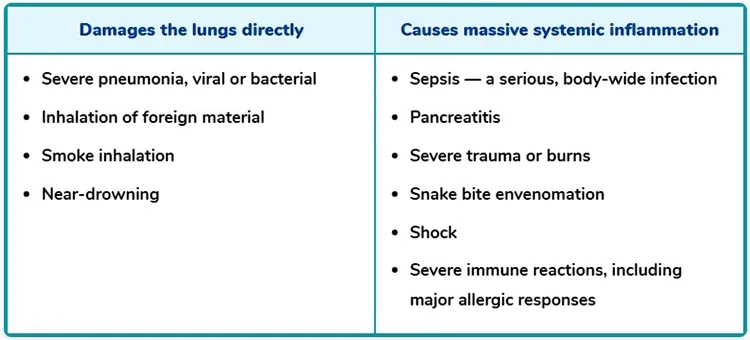
In every case, the dog is already very sick. ARDS is what can happen when their body's response to that illness spirals out of control.
Researchers have shown that part of what makes ARDS so destructive is the immune system flooding the body with chemical messengers called cytokines. In normal amounts, cytokines help cells communicate during infections and inflammation. But when too many are released at once, they can drive the kind of massive lung inflammation seen in ARDS — making the lungs more inflamed, breathing more difficult, and oxygen levels dangerously low.12
Warning Signs to Watch For
The signs of ARDS can come on quickly, sometimes within hours, and they should always be treated as a medical emergency:13,14
- Rapid or labored breathing
- Open-mouth breathing
- Bluish or pale gums and tongue, from poor oxygen levels
- Coughing or wheezing
- Abnormal lung sounds your veterinarian may hear with a stethoscope
- Pink, foamy fluid coming from the nose or mouth
- Fever and lethargy
- Collapse
- Low blood oxygen readings if your dog is being monitored
If your dog shows any combination of these signs, do not wait. Get to a veterinarian or emergency clinic immediately. ARDS can worsen within hours, and early intervention offers the best chance of survival.
How Veterinarians Diagnose It
Because ARDS develops in dogs who are already critically ill, the workup is usually fast and thorough. The most important test is a blood gas analysis — a blood test that measures how much oxygen and carbon dioxide are in the blood. It tells the veterinarian how well the lungs are actually doing their job. Your vet will likely also run:15,16
- Thoracic radiographs (chest X-rays) to look at the lungs
- An echocardiogram (ultrasound of the heart) to rule out cardiac causes
- Complete blood count, biochemistry panel, and urinalysis to assess overall health
- Additional tests — abdominal radiographs (X-rays), ultrasound, bacterial cultures, sometimes exploratory surgery — to find the underlying cause if it is not already known
The updated 2025 ARDSVet definitions give veterinarians clearer criteria for diagnosing the syndrome, factoring in risk factors, when and how fluid built up in the lungs, and how impaired the dog's oxygenation is. The definitions also account for whether the dog is on a ventilator or breathing on their own.17
What Treatment Looks Like
Dogs with ARDS are critically ill and need 24-hour care, ideally at a referral center with emergency and critical care specialists. Treatment has two main parts.
First, the underlying cause has to be identified and treated. Calming the systemic inflammation that is driving ARDS depends on getting control of the original problem — sepsis, pancreatitis, trauma, whatever it may be.
Second, the lungs need direct support while that is happening. In the early stages, this often means supplemental oxygen, given through an oxygen cage or a nasal line. In more severe cases, dogs are placed on a mechanical ventilator — fully anesthetized, with an endotracheal tube in the windpipe, and the ventilator breathing for them. The goal is to keep oxygen levels high enough for survival while the underlying condition is treated.18 Other parts of the treatment plan typically include:19
- Carefully balanced IV fluids — keeping circulation strong without making the lung fluid problem worse
- Supplemental nutrition through a feeding tube or IV, since the effort of breathing burns through energy quickly
- Anti-inflammatory or immunomodulatory medications
- Antibiotics if infection is involved
There is an important caveat: no single medication has been proven to reliably treat ARDS itself. Drug responses vary widely. What works is time, supportive care, and treating the underlying cause of the inflammatory response.20
The Hard Truth About Prognosis
This is the part no pet parent wants to read. Even with aggressive treatment — including mechanical ventilation — many dogs with ARDS do not survive. The mortality rate for veterinary patients is approximately 70% to 90% unless mechanical ventilation can be provided for more than 24 hours.21 Patients receiving mechanical ventilation for over 24 hours showed a 52% survival rate in a 2026 publication. Even in human medicine, where the condition has been studied for decades and resources are extensive, mortality is roughly 40% to 60%.22
That number is hard to absorb. But it is also why early recognition matters so much. The dogs with the best chance of pulling through are the ones who get into critical care fastest — before the syndrome has had time to do its full damage.
When Every Minute Counts
If your dog is already hospitalized for a serious illness, the veterinary team will be watching for signs of ARDS. If your dog is home, the warning signs to act on immediately are:
- Difficulty breathing or visible struggle to take a breath
- Open-mouth breathing in a dog who is not panting from heat or exercise
- Blue, gray, or very pale gums
- Collapse or extreme weakness
- Pink, foamy discharge from the nose or mouth
Do not wait to see if it gets better. Call your veterinarian or head straight to an emergency clinic. With ARDS, hours matter.23
The Bottom Line
ARDS is not a routine respiratory problem. It is a rare, serious, and unpredictable complication of critical illness. The good news is that veterinary medicine is getting better at recognizing it, with new consensus definitions now helping veterinarians diagnose it more consistently.
The other piece — the piece every pet parent can act on — is awareness. Knowing what severe breathing trouble actually looks like, knowing that the timeline can move in hours rather than days, and knowing that pale gums or open-mouth breathing in a dog at rest is an emergency, not a wait-and-see.
Most coughs and sniffles are not ARDS. But when breathing trouble is the kind that scares you, trust that instinct. Get help right away. With a condition this fast and this serious, the fastest call is almost always the right one.
Sources and References
- 1 Respiratory Care 67(6):respcare.09832, December 2021
- 2 Am J Respir Crit Care Med. 2005 Jul 14;172(7):798–806
- 3 Vet Folio, August 2001 (Vol 23, No 8)
- 4,8,11,14,16,18,20,22 VCA Hospitals, Acute Respiratory Distress Syndrome (Shock Lung) in Dogs
- 5,17 J Vet Emerg Crit Care (San Antonio). 2025 Jul-Aug;35(4):327-338
- 6 Journal of Veterinary Emergency & Critical Care, Volume 35, Issue 4, July/August 2025
- 7 Respir Res. 2025 Feb 13;26:54
- 9,10,12,13,15,19,23 NHV Natural Pet, Acute Respiratory Distress Syndrome (ARDS) in Dogs
- 21 J Am Vet Med Assoc. 2025 Dec 17;264(5):1-7

Better Health Begins in the Bowl

Better Health Begins in the Bowl
The Ultimate Pet Nutrition Guide was created to help dog and cat parents understand what truly supports lifelong health.
In this free guide, you’ll discover:
-

How your pet’s biology influences their nutritional needs
-
Why conventional feeding advice often falls short
-
Practical ways to choose better food for your dog or cat
View our Privacy Policy and Terms of Service.