Could Your Dog's Dream Life Be Richer Than You Think?
Harvard researchers say your dog's dreams may be more interesting than you think — and you're probably starring in them.
Reviewed by Dr. Elizabeth Hardoon


Join the Bark & Whiskers™ Family
Sign up today for our FREE newsletter, packed with expert advice and insider tips to keep your beloved pet in tip-top shape.
View our Privacy Policy and Terms of Service.


STORY AT-A-GLANCE
- Yes, your dog dreams — modern EEG studies show that during sleep, your dog's brain wave patterns are almost identical to yours, including the deep, vivid REM sleep stage where dreaming happens
- The twitching paws, tail swishes, soft barks, and lip licks you've noticed are your clearest signs that a dream is unfolding behind those closed lids
- Dogs likely dream about their day — research on rats showed their sleeping brains replay the exact mazes they ran earlier, suggesting dogs do something similar with food, play, people, and especially smells
- Harvard psychologist Dr. Deirdre Barrett concluded that your dog is probably dreaming of your face, your smell, and of pleasing — or annoying — you, since dogs dream about whatever they're most emotionally attached to
- Better days make better dreams; a steady routine, enough exercise, a cozy bed, and a balanced diet all support deeper, more restful sleep — and any sudden change in your dog's sleep pattern is worth a vet visit
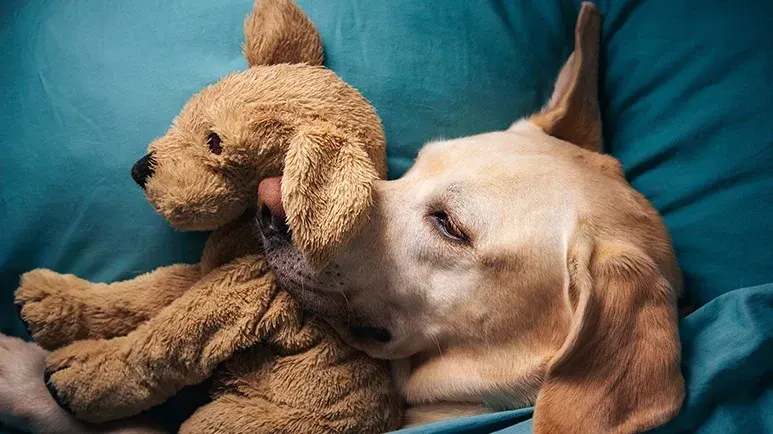
You've probably watched it happen a hundred times. Your dog is curled up on the couch, eyes shut, and suddenly their paws start twitching. Their tail gives a little swish. A muffled bark slips out and their nose wrinkles like they’re catching a scent only they can smell.
So, what's going on in there? Are they really dreaming? And if they are, what's they dreaming about?
Here's the short answer: Yes, your dog almost certainly dreams. And the long answer is even more interesting. New research suggests their dream world may be far richer, more emotional, and more tied to you than most people realize.1,2
Science Finally Caught Up
For most of the 20th century, scientists pushed back against the idea that animals dream. Many call it as anthropomorphizing — putting human traits onto non-humans. Back in the 1800s, most researchers agreed that nearly all mammals had vivid dreams, but that view fell out of favor for decades.
Today, science is shifting back. EEG studies — tests that measure electrical activity in the brain — show that when your dog is asleep, their brain wave patterns look almost identical to yours. Their brain cycles through the same kinds of stages, including Rapid Eye Movement (REM) sleep — which is the deep, vivid dreaming stage in humans.3,4
Researchers now believe dreaming is something many species share, not just humans. Signs of REM sleep have been found in dozens of mammals — and, more surprisingly, in birds, reptiles, octopuses, and even spiders.5
The Signs You're Watching a Dream Happen
Just like you might talk, twitch, or laugh in your sleep, dogs respond physically to their dreams. You've probably already seen the signs without realizing what they were. Common signs of a dreaming dog include:6
- Paw twitching
- Body twitching
- Whimpering or whining
- Soft barking or grumbling
- Eye flickering behind closed lids
- Tail swishing
- Lip licking
These are the clearest clues we have. Until dogs learn to talk — and wouldn't that be something — we have to rely on physical signals. That's not as flimsy as it sounds. We read body language in other people all the time. Someone limps, and you guess they're hurt. Someone laughs, and you assume something was funny. The same logic works with your dog.
So What Are They Dreaming About?
This is where it gets fun. You can't ask your dog directly, but researchers have some solid theories.
It appears dogs dream about their day. EEG studies on rats showed that when the animals slept, their brain activity matched the exact patterns they made while running through a maze earlier. Researchers could even tell where in the maze the rat was 'running' in its dream. If rats can replay their day in their sleep, it's reasonable to think dogs — with more complex brains — are doing something similar.
Dogs also likely dream about whatever matters most to them: food, playing, their people, and smells. Dr. David Peña-Guzmán, author of When Animals Dream: The Hidden World of Animal Consciousness, points out that a dog's dream wouldn't look like yours. It would be built from a dog's perspective of their life and a dog's senses. Since dogs experience the world mostly through their noses, scent is probably a big part of their dreams — something rarely true for humans.7
And Yes — They May Be Dreaming About You
Here's the part that pet parents love. According to research by Dr. Deirdre Barrett, a clinical and evolutionary psychologist at Harvard Medical School, your dog is probably dreaming about you.
Dr. Barrett studied sleep behavior and concluded that dogs likely dream in a way similar to humans — replaying daily experiences in ways that can feel vivid and a little strange. Because dogs aren't logical thinkers, their dreams probably focus on what they find interesting and what they're emotionally attached to.
“Since dogs are generally extremely attached to their human owners, it's likely your dog is dreaming of your face, your smell and of pleasing or annoying you,” she explains.8
When the Dream Looks Like a Nightmare
Sometimes, your dog's dream doesn't look so happy. They whimper, kick, or make whining sounds that tug at your heart. It's natural to want to wake them up. But experts generally recommend letting them sleep.
Here's why: It's hard to tell whether your dog is having a good dream or a bad one. Twitching and chasing motions could just as easily be a happy run in the park. And dreams — even unsettling ones — can act as a kind of stress reliever for both humans and dogs.9
That said, dogs can experience real fear and anxiety, and studies on post-traumatic stress disorder (PTSD) in dogs show they can develop symptoms like humans, including sleep disturbances. For dogs with a history of trauma, abuse, or neglect, nightmares may be more common. If your dog has had a rough past, this is something to be mindful of — not panicked about. A calm, secure home and a steady routine go a long way. Using calming supplements for support natural dog- safe essential oils and homeopathic remedies may help in these situations as well.
Better Days Make Better Dreams
Your dog's waking life shapes his sleeping life. Dogs that lead happy, well-balanced days tend to settle into healthier sleep habits — and probably better dreams along with them. A few simple things support good sleep:10
- A cozy bed in a calm, comfortable spot
- A steady routine for feeding, walking, and bedtime
- A last potty break right before lights-out
- Enough play and exercise during the day — a tired dog sleep better
- Lower energy time, plus extra cuddles, in the hour before bed
Diet matters, too. A high-quality, balanced whole food diet supports gut health and brain chemistry, which can reduce restlessness and help your dog fall into deeper, more restful sleep.
So how much sleep do dogs need? Quite a bit, actually. Here’s a guide to help you get a clearer picture:
- Adult dogs — 12 to 14 hours a day
- Puppies — 16 to 20 hours, since they grow so fast and tire quickly
- Larger breeds and quick dogs like greyhounds — around 18 hours
If your dog's sleep changes suddenly, they exhibit restlessness, pacing, or waking up more often — that's worth a vet visit. Sleep changes can sometimes signal an underlying issue like pain from arthritis or the development of cognitive changes such as “doggy dementia”.11
A Quiet Window Into Their Inner World
We may never know exactly what your dog sees behind their closed eyes — just like they’ll never know what plays out behind yours. But the evidence keeps piling up that their dream life is real, emotional, and shaped by everything they love: their daily routines, toys, and the people they’re bonded to.
So, the next time you catch them paddling their paws in their sleep, take a second to watch. They might be running through fields, chasing a squirrel, or — if the research is right — dreaming about you. Either way, it's a small, quiet reminder that there's more going on in that fuzzy head than we'll ever fully understand.
Sources and References

Better Health Begins in the Bowl

Better Health Begins in the Bowl
The Ultimate Pet Nutrition Guide was created to help dog and cat parents understand what truly supports lifelong health.
In this free guide, you’ll discover:
-

How your pet’s biology influences their nutritional needs
-
Why conventional feeding advice often falls short
-
Practical ways to choose better food for your dog or cat
View our Privacy Policy and Terms of Service.