Why Your Cat Thinks Gravity Is a Game
Behind your cat's deliberate paw nudge that sends your belongings off the counter is a mix of curiosity, hunting drive, and a surprising interest in how things fall. Here's what's going on (and what you can actually do about it).
Reviewed by Dr. Arielle Walton




Join the Bark & Whiskers™ Family
Sign up today for our FREE newsletter, packed with expert advice and insider tips to keep your beloved pet in tip-top shape.
View our Privacy Policy and Terms of Service.


STORY AT-A-GLANCE
- Cats knock things off surfaces out of curiosity, hunting instinct, and a need for mental stimulation, not to deliberately annoy their owners
- Your cat's paws are highly sensitive, helping them gather information through touch and detect differences in texture, temperature, and movement
- Not every knocked-over object is intentional — tail movement, misjudged distances, and crowded surfaces can all send items tumbling to the floor
- Cats that receive attention after knocking something over learn to repeat the behavior, making your reaction a key part of the cycle
- Redirecting with interactive toys, vertical spaces, and enrichment gives cats better outlets and significantly reduces unwanted counter-clearing behavior over time
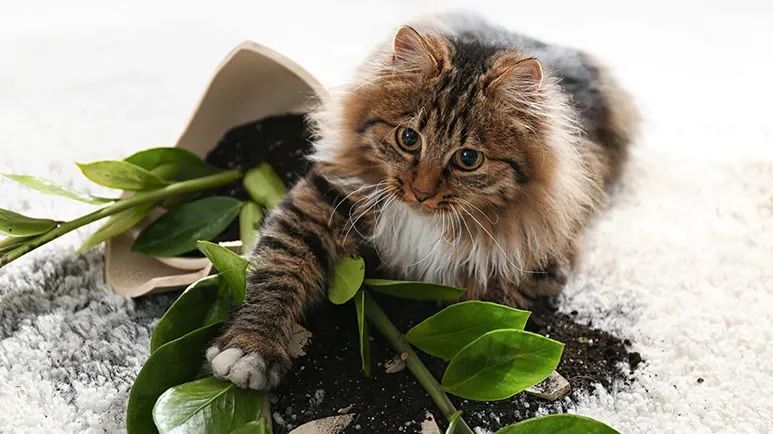
If you live with a cat, you’ve likely seen this play out more than once: Your cat jumps onto the counter, pauses, locks eyes with you, and slowly extends a paw toward the nearest object. A glass, your keys, your phone, it doesn’t matter. With a deliberate nudge, it slides off the edge and hits the floor.
As satisfying as it might feel to call this straight-up mischief, that paw-to-floor pipeline your cat has perfected actually follows a pattern rooted in how cats interact with their environment. What looks like destruction often means your cat is following its instincts. It tests, learns, and plays with gravity.
Why Does Your Cat Knock Things Off the Counter?
A single swipe of the paw serves several purposes at once. This explains why the behavior appears so consistently across cats of all personalities and living situations. Common drivers include:1,2
- Curiosity and exploration — Cats rely on their paws to understand what’s in front of them. Unlike dogs, which often use their mouths to explore, cats gather information through touch. Their paws are highly sensitive, allowing them to detect subtle differences in texture, temperature, and movement. A light tap reveals how an object responds, and a stronger push gives a fuller picture of its behavior.
- Mental stimulation — Objects that slide, tip, or fall create movement and sound, which hold a cat’s attention. For an indoor cat with limited entertainment options, a falling object becomes a form of solo play, particularly when it rolls, bounces, or breaks. Over time, these repeated interactions also help cats map their environment.
- Hunting instincts — Domestic cats carry the same hunting patterns as their wild counterparts. In a natural setting, a cat bats at prey to trigger movement, test its response, and position it for capture. That same sequence appears during everyday interactions. A swipe sets an object in motion, and the cat follows the result, tracking how it moves and where it lands.
- Attention-seeking — Cats pay close attention to how you respond to their actions. Knocking something off a surface often leads to immediate engagement — you look over, move toward them, or speak. Over time, the behavior becomes a reliable way to draw you in.
High-energy breeds like Bengals, Siamese, and Abyssinians tend to be the most enthusiastic practitioners of this behavior. But any indoor cat left without enough stimulation is likely to find its own solution, often involving your belongings and the edge of a surface.
When It’s Accidental vs. Intentional
Not every object that ends up on the floor gets there on purpose. Cats navigate spaces that humans have filled edge-to-edge with objects, and they don't always factor in what's sitting two inches from their back leg. A stretch, a turn, or a casual repositioning on a cluttered surface can send things over the edge with zero intent behind it.
Tail movement also plays a role, especially in cats with long or full tails that sweep across surfaces as they move. Misjudged jumps and tight spaces account for a few casualties, too, especially in bigger cats. These cases lack the focused paw movement seen in deliberate swats and reflect normal movement.3
How to Redirect the Behavior Without Fighting It
You're not going to out-stubborn your cat. What you can do is make their current destructive hobby less appealing and everything else a lot more interesting. A few adjustments to their environment and daily routine go further than any amount of firmly saying “no.” Here's where to start:4,5,6
- Give them a better outlet — A bored cat is a destructive cat, and the fix is usually simpler than it sounds. Toys that move unpredictably scratch the hunting itch without involving your belongings. Puzzle feeders turn mealtime into a mental workout. Even a few minutes of active play each day can help release built-up energy and reduce the need to create stimulation elsewhere.
- Build a cat-friendly environment — Cats want to be up high, in charge, and watching everything. If you give them a designated place to do that — a cat tree, some wall shelves, a perch near a window with a view worth having — they're far less likely to use your kitchen counter as a lookout post.
- Remove the temptation — Objects placed near edges are easy targets. Keeping surfaces clear, moving lightweight or frequently used items away from edges, and securing fragile objects or storing them out of reach reduce the opportunities for this behavior.
- Change your response — Every time you react to a knocked-over object, even if that reaction is frustration, your cat files it away as a result worth repeating. Limiting your response, as difficult as that is in the moment, breaks the pattern. Redirect the praise and attention to behaviors you'd actually like to see more of.
- Add enrichment and rotation — Cats get bored with the same toys for the same reason you'd get bored eating the same lunch every day. Rotating what's available, mixing up textures and movement styles, and occasionally introducing something new keeps their attention on things that belong to them rather than things that belong to you.
You Can Have the Upper Hand
You don't need to overhaul your home or outsmart your cat at every turn. What works is simpler than that — meet their needs before they go looking to meet them themselves. A good play session, a perch near the window, a toy that actually holds their attention — these small additions change the dynamic entirely.
Your cat is curious, clever, and responsive to the environment you create for them. That means you have more influence over this behavior than you might think. Use it, and you might be surprised how quickly the pattern shifts.
Sources and References

Better Health Begins in the Bowl

Better Health Begins in the Bowl
The Ultimate Pet Nutrition Guide was created to help dog and cat parents understand what truly supports lifelong health.
In this free guide, you’ll discover:
-

How your pet’s biology influences their nutritional needs
-
Why conventional feeding advice often falls short
-
Practical ways to choose better food for your dog or cat
View our Privacy Policy and Terms of Service.