Your Vet Heard a Heart Murmur — Now What?
When your fur baby's heartbeat sounds more like a 'whoosh' than a 'lub-dub,' a heart murmur may be to blame. Here is what this really means for your dog or cat.
Reviewed by Dr. Tracy Duffner




Join the Bark & Whiskers™ Family
Sign up today for our FREE newsletter, packed with expert advice and insider tips to keep your beloved pet in tip-top shape.
View our Privacy Policy and Terms of Service.


STORY AT-A-GLANCE
- Heart murmurs are extra sounds your veterinarian picks up with a stethoscope when blood does not flow smoothly in one direction through the heart. Think of a murmur as a clue, not a verdict — it tells your vet something is worth a closer look
- Veterinarians grade murmurs from I to VI based on loudness and where they are heard, but volume cannot predict how serious the heart disease is, or how long your pet lives
- Some puppies and kittens have innocent murmurs that fade with growth or rarely murmurs stemming from congenital abnormalities, while adults develop murmurs from leaky valves, thickened or dilated heart muscle, heartworms, or other heart problems that worsen over time
- Warning signs a murmur may be serious include coughing, fast breathing at rest, tiring easily, fainting or collapse, bluish gums, or a swollen, fluid-filled belly. These are signs that your pet should be checked immediately
- Blood tests, chest radiographs (X-rays), electrocardiograms, and echocardiograms (ultrasound of the heart) help pinpoint the cause so your veterinarian can decide whether to monitor, start medications, recommend procedures, or adjust lifestyle and nutrition for support
Just like humans, our furry family members can face heart issues too — and sometimes the very first clue is not something you can see, but something your veterinarian hears. Why would a perfectly happy, tail-wagging fur baby suddenly have a "whisper" in their chest? And what does that extra sound mean?
These are the kinds of questions that come up when a veterinarian detects a heart murmur during a routine check-up, and understanding the answers can help every paw-rent feel more confident about what comes next.
The Anatomy of a Heart Murmur
In her website ToeGrips, integrative veterinarian Dr. Julie Buzby1 defines a heart murmur as “an abnormal sound that can be heard when listening to the heart using a stethoscope.” Instead of a clean 'lub-dub,' there is an extra sound — almost like a soft rushing noise — layered into each beat. A heart murmur usually means something is changing in the way blood moves through your dog’s heart.
Normally, your dog or cat’s heart has four chambers and a set of valves2 that act like tiny one-way doorways between them. Blood should flow forward smoothly and steadily as the heart squeezes and relaxes. When that flow becomes rough or “turbulent,” it alters normal heart sounds and creates a murmur. According to Pet MD, turbulence may happen when:3
- A valve becomes leaky, so some blood slips backward
- A valve or blood vessel is too narrow, forcing blood through a tight opening
- A small hole between chambers or vessels
- Your fur baby’s heart beats too fast because of stress or excitement
- Your pet’s blood is thin because of anemia
- Your pet’s blood pressure is elevated, which has the same effect as forcing blood through a tight opening or narrow channel
Because murmurs can sound very different from one dog to another, veterinarians classify them by grade (how loud the murmur is), configuration (when the heartbeat cycle is loudest), and location (which part of the chest the murmur is heard best).
How Do Veterinarians Measure the Loudness of a Murmur?
Your veterinarian considers a few things when describing a murmur, but the one you will hear about most is the grade — basically, how loud it is. Veterinarians grade heart murmurs on a scale of 1 to 6 based on loudness. It is a subjective scale, meaning it is based on what the veterinarian hears and feels.4,5
- Grade I — Very soft, only heard by a trained ear in a very quiet room
- Grade II — Soft but clearly audible
- Grade III — Moderately loud; this is a very common grade in everyday practice
- Grade IV — Loud murmur that can be heard over a larger area of the chest, often on both sides
- Grade V — Very loud murmur with a noticeable “thrill,” a faint vibration you can feel when you rest your hand on the chest; the murmur is audible with the stethoscope only lightly touching the chest6
- Grade VI — The loudest murmur; you can often hear it before the stethoscope even touches the chest, and the vibration is easy to feel
The grade tells you how it sounds, not automatically how serious the problem is. A quiet murmur can mask significant disease, and a loud murmur can sometimes signal a more manageable condition. That is why your veterinarian looks at the whole picture before making a diagnosis or treatment plan.
Heart murmurs happen more than most pet owners realize. About 1 in every 30 dogs7 that visit the vet has a murmur, and the odds go up for small-breed and senior pups. Cats are even trickier. Believe it or not, more than one-third of kitties will have a heart murmur at some point in their lives.8 The encouraging news is that about half of otherwise healthy cats with a murmur do not have underlying heart disease, and many of those who do still live normally without ever showing symptoms.
What Causes Heart Murmurs?
In dogs, the most frequently diagnosed heart issue is mitral valve disease (MVD). Remember those tiny doorways we talked about? In MVD, the mitral valve, one of the heart's busiest doors, wears down over time and stops sealing tight, letting blood slip backward with each beat.9
This backward flow creates the murmur your veterinarian hears, while gradually placing extra strain on the heart. The condition is especially common in older, small‑breed dogs such as Cavalier King Charles Spaniels, Chihuahuas, Toy Poodles, Maltese, Shih Tzus, Pomeranians, and other breeds under 15 kilograms (kg).
Here is the number that matters: without treatment, roughly 56 out of 100 dogs with a new Grade IV murmur went on to develop heart failure within five years. With treatment, that number dropped to about 34.10,11,12 That is a real difference — and it shows why catching things early can make a big difference for your fur baby.
In cats, the most common heart condition is hypertrophic cardiomyopathy (HCM). This disease causes abnormal thickening of the heart muscle, making it harder for the heart to relax and pump efficiently. Certain breeds are more prone to HCM, including Maine Coons, Persians, American Shorthairs, and British Shorthairs. Many cats with HCM have murmurs; others do not, which is why a murmur in a cat is considered a clue rather than a definitive diagnosis.13
How Vets Figure Out Whether a Murmur Is a Big Deal
Once a murmur is confirmed, your veterinarian starts gathering clues. They will ask about your pet’s appetite, activity level, nighttime breathing, coughing, fainting spells, or any changes you have noticed at home.
If anything suggests that your pet’s murmur is tied to a heart problem or another illness, your veterinarian may recommend further testing. Many families are referred to a board-certified cardiologist for an echocardiogram (echo), an ultrasound of the heart. This test is considered the gold standard because it reveals measurements of the heart chambers and major vessels, how the valves open, how blood moves, and where the flow gets turbulent.14
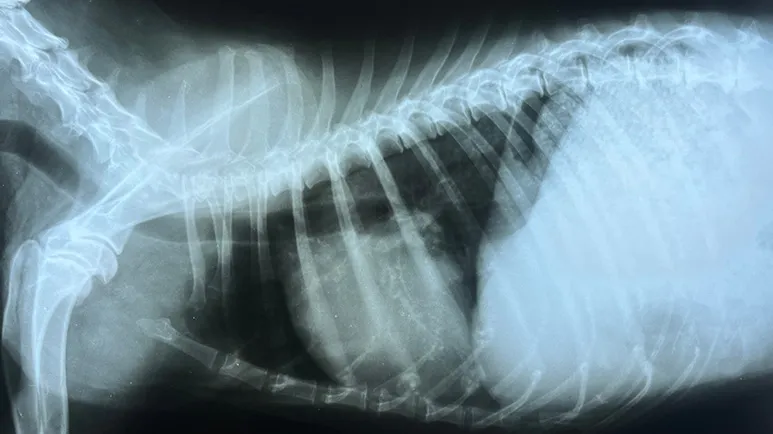
Some dogs also need chest radiographs (X-rays) or an electrocardiogram (ECG), especially if the rhythm sounds abnormal. Bloodwork may be added if the murmur could be due to anemia, infection, hormone imbalances, or other systemic conditions.15
Tell-Tale Signs of Heart Trouble
Heart trouble does not always announce itself — sometimes the earliest signs are easy to miss. Here is what to watch for, from subtle to serious:16
- Subtle signs you might want to tell your vet — Your fur baby tires more quickly on walks, seems less interested in playtime, or coughs now and then, especially at night or after excitement.
- Call your veterinarian within the day when these signs show up — You notice faster breathing at rest, a belly that looks rounder or feels tight, or your pet seems weak or unsteady on their feet.
- Head to the vet right away if you see these — Bluish or gray gums, fainting or collapse, or open-mouth breathing or sudden weakness in the back legs (especially in kitties) are red flags that cannot wait.
- An easy way to check your pet's breathing at home — According to Tufts University's Cummings School of Veterinary Medicine, one of the simplest ways to keep tabs on your fur baby's heart health is to count their breaths while they rest.17
Watch your fur baby's chest rise and fall while they are sleeping and count the breaths for one full minute. For both dogs and cats, a normal resting rate is under 30 breaths per minute — anything consistently above that is worth a call to your vet. Quick tip for kitty parents: Make sure your cat is not purring when you count, since purring naturally speeds up the rate. Also, if your pet is actively dreaming, this can temporarily elevate respiratory rate.
If you have noticed any of those warning signs, or your veterinarian just found a murmur on a routine visit, the next question is, what can you actually do about it?
How Are Heart Murmurs Treated in Dogs and Cats?
A heart murmur is a sound — not a diagnosis18 — which is why treatment always focuses on what is causing the turbulent blood flow in your pet’s heart, not the murmur itself. Some murmurs are completely harmless, especially in growing puppies and kittens, while others signal that the heart needs a little extra help.19
When medication is the first step, these prescriptions can help reduce fluid buildup, improve the heart's efficiency, relax blood vessels, or regulate the heart’s rhythm. If heart failure is in the picture, your fur baby may need a hospital stay with oxygen support and medications.20 Kitties with fluid pressing on their lungs (a condition called pleural effusion) may need a procedure called thoracocentesis — a careful draining that helps them breathe more freely again.21
When a murmur is caused by something outside the heart, such as anemia, low blood protein, or hyperthyroidism in cats,22 treatment focuses on the underlying problem. As your dog or cat's overall health stabilizes and blood values return to normal, the extra "whoosh" in the chest often quiets down.
When watching and waiting is the plan, some pets need regular monitoring rather than immediate treatment. Innocent murmurs in puppies, kittens, or anxious adult pets often require nothing more than periodic checkups and repeat imaging to ensure the heart continues to function normally. Even mild heart disease can usually be managed effectively with regular rechecks and medication adjustments over time.
When a procedure or surgery might help, minimally invasive procedures may be recommended. Congenital conditions such as patent ductus arteriosus (PDA) or pulmonic stenosis can sometimes be corrected, and repair may reduce or eliminate the murmur. For heartworm disease, dogs may need staged treatments to safely remove the parasites. For arrythmias, some pets may benefit from pacemaker placement.
Every pet's heart tells a different story, and there is no one-size-fits-all plan. Your veterinarian will guide you through the options, explain what to expect, and help you choose the path that supports your fur baby's comfort, happiness, and time by your side. Do not be shy about asking questions — like what grade the murmur is, whether further testing is needed, and what you should be watching for at home. The more you know, the better you can care for your canine or feline companion.
Sources and References
- 1,5,9,15,16,19 ToeGrips, January 12, 2026
- 2 Tufts Cummings School of Veterinary Medicine, Heart Disease Basics
- 3,4,13,21,22 PetMD, January 28, 2025
- 6 StatPearls. Physiology, Cardiovascular Murmurs, July 17, 2023
- 7,10 Petgevity, September 23, 2025
- 8 Heart murmurs and heart disease, Cats Protection
- 11 PLoS One. 2025 Jun 18;20(6):e0325695
- 12 J Vet Intern Med. 2016 Nov;30(6):1765-1779
- 14 VetSpecialists.com, April 20, 2020
- 17 Tufts Cummings School of Veterinary Medicine, Monitoring Heart Disease Treatment at Home
- 18 Mallard Creek Veterinary Hospital, December 18, 2024
- 20 VCA Animal Hospitals, Heart Murmurs in Dogs

Better Health Begins in the Bowl

Better Health Begins in the Bowl
The Ultimate Pet Nutrition Guide was created to help dog and cat parents understand what truly supports lifelong health.
In this free guide, you’ll discover:
-

How your pet’s biology influences their nutritional needs
-
Why conventional feeding advice often falls short
-
Practical ways to choose better food for your dog or cat
View our Privacy Policy and Terms of Service.