The Dreadful New Pet Adoption Scheme You'll Want to Avoid Like the Plague
Two young women didn't realize their puppy came with a lease-to-own contract hidden in fine print. The final cost was more than double, with steep penalties for missed terms. Be aware of this scheme — don't let them profit at your expense.

Reviewed by Dr. Becker

Join the Bark & Whiskers™ Family
Sign up today for our FREE newsletter, packed with expert advice and insider tips to keep your beloved pet in tip-top shape.
View our Privacy Policy and Terms of Service.
STORY AT-A-GLANCE
- Even after decades of campaigns to raise awareness, there are still way too many people acquiring pets from retailers who keep puppy mills in business
- The puppies‑for‑profit business increasingly relies on lease‑to‑own pets, a system that often results in owners paying over double the listed price
- There are many things concerned pet lovers can do to put puppy mills out of business; number one is to refuse to acquire an animal from a pet retailer unless they’re offering only adoptable pets from shelters or rescues
- Don’t buy a pet on impulse, or from backyard breeders advertising on the Internet
- Consider adopting your next furry family member from a shelter or rescue
Editor's Note: This article is a reprint. It was originally published July 28, 2018.
In an ideal world, puppy mills and the brick‑and‑mortar and online pet retailers that buy from them — would shut down simply because nobody would support them. Unfortunately, too many people still don’t recognize what they’re funding when they make an impulse puppy purchase at a mall or intentionally shop at commercial pet stores for a specific purebred or “designer” dog.
Puppy Profiteers
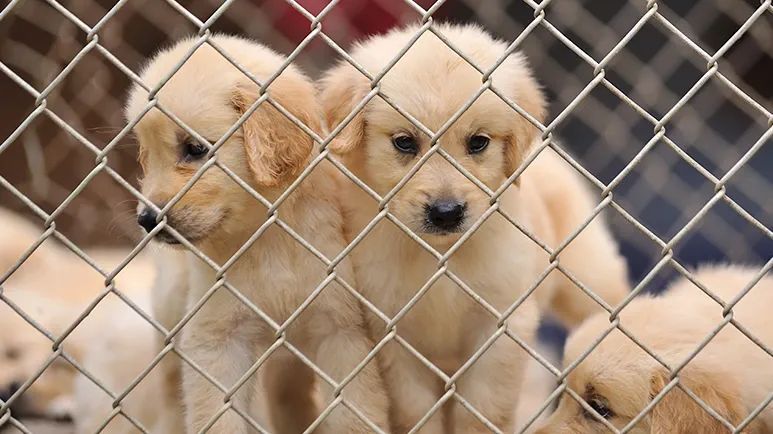
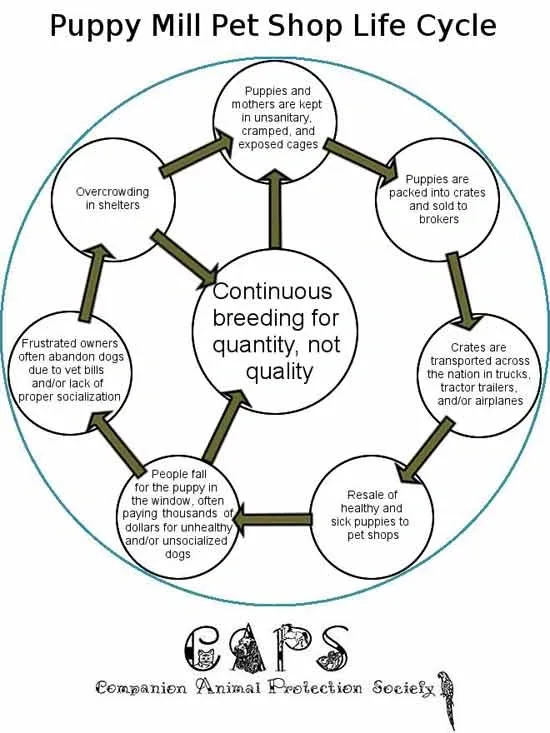
Most pet mills that supply commercial puppy sellers are filthy operations in which animals are subjected to cruel treatment and inhumane living conditions. They exist primarily to put money in the pockets of mill operators and pet store owners. According to Best Friends Animal Society:
“A puppy mill is a high-volume commercial dog-breeding operation in which profit and maximum production take priority over the health and welfare of the animals. Puppies bred in these factory-like settings are regarded as nothing more than a cash crop commodity, and despite the poor conditions in which the breeder dogs are forced to live, puppy mills are still legal in every state.”1
There are approximately 10,000 puppy mills in the U.S., both licensed and unlicensed, with the majority located in the Midwest that produce an estimated 4 million puppies per year, which is about the number of dogs killed in U.S. shelters each year.2
If you’re wondering why mill operators continue to manufacture puppies when so many dogs who already exist are being destroyed every day because there’s no one to adopt them, the answer is simple: profit. Retailers are the big winners because they buy puppies at a low cost from the mills and then resell them at a high markup.
‘Lease to Own’ Puppies
There’s a heinous twist to the puppies-for-profit scheme: leasing. CBS News tells the story of two young women in Brooklyn, NY, roommates, who fell in love with a designer “Frenchton” (a French Bulldog, Boston Terrier mix) at a pet store.3 The puppy was selling for $1,350, which was a price the roommates couldn’t afford, so a salesman talked them into “leasing” her.
Once home with their pup, they looked more closely at their contract and realized she wouldn’t belong to them until they’d paid around $3,300 for their $1,350 pet over a two-year period. If the roommates failed to keep up their monthly payments, the store would repossess their living, breathing, and sentient pet as though she were a car.
Of course, pet retailers love leases not only for the exorbitant monthly “lease fees,” but also because they’re able to sell pets while they’re still puppies and therefore at their most desirable age. Wags Lending, a 5-year-old company, says they have “… carefully crafted a lease purchase agreement so that you can enjoy the pet that you have always wanted, when you want.”4
The company claims it doesn’t charge interest, but rather, “monthly rental fees and monthly depreciation.” From the Wags Lending pricing page:
“The monthly lease payment is calculated by adding two numbers together. The first component of the monthly payment is the ‘rent’ that the leasing company charges the customer in exchange for the customer’s right to possess and use the product.
This rent charge accounts for the leasing company’s risk in the same fashion an interest rate in a loan accounts for the lender’s risk, but with additional costs because the leasing company owns the product. The second component of the monthly payment is the product’s monthly depreciation. Each month the customer possesses and uses the product, the product’s fair market value decreases.
That decrease is part of the monthly payment so that the customer is compensating the business for the decrease in the product’s fair market value while the customer is using the product. These two numbers, added together, make up the monthly payment calculation.”5
Wags Lending appears to be trying to avoid being called a predatory lender by parsing words. Most offensive, of course, is the reference to pets as “products” that are “used” and “depreciate.” Fortunately, both Nevada (where Wags Lending is based) and California have now outlawed the leasing of pets, and New York lawmakers are proposing legislation as well. Here’s hoping all states where this despicable practice is taking place will follow suit.
5 Ways You Can Help Put Puppy Mills Out of Business
You may not be able to shut down puppy mills overnight, but small, informed choices still matter — and each one is a practical way to show you won’t support them.
- Don’t buy a puppy from a pet store, since most receive their “inventory” from puppy mills, and don’t purchase a puppy online from an Internet seller. Remember, you don’t “rescue” a puppy from a pet store; you perpetuate the breeding cycle. When people stop doing business with puppy retailers, puppy mills will go out of business.
Also, avoid buying your pet supplies from businesses that sell puppies. As the American Society for the Prevention of Cruelty to Animals (ASPCA) makes clear:
“Consumer action is a critical element in the fight against puppy mills. Convincing consumers not to shop for anything — including puppies and supplies — at stores that sell puppies is the most effective way to stop the demand for puppy mill dogs.”6
- Don’t ever make an impulse purchase of a pet. Taking on the responsibility of caring for a dependent creature isn’t something you should do on a whim. It’s a decision that requires careful thought, research, planning and preparation.
When it comes to those adorable puppies being sold at your local mall, or on Craigslist, or out of the back of a truck in the grocery store parking lot, as cute as they are, and as much as you may think they need you, just say no. Don’t help puppy mill and unethical backyard breeders stay in business. - If you have your heart set on purchasing a purebred pup, try to buy from a local, reputable breeder. Make sure to check his or her background and references. Review the sales contract closely. A reputable breeder will want to meet and interview anyone interested in buying a puppy, as well as be proud to show you the parents, their living environment and their medical records. That's why you won't find responsible breeders selling to pet stores.
At industry events such as SuperZoo, there are breeders who intentionally create so‑called “designer dogs” for people with allergies. These breeders carefully screen both parent dogs for possible genetic flaws, then produce what they describe as “healthy hybrids” — often marketed as fashionable mixed breeds — to meet demand from a long list of buyers.
Although the topic of designer dogs is very controversial, it’s encouraging to see this woman test for genetic flaws, something many breeders still refuse to do. She also welcomes visits to her home, and insists all dogs are returned to her if, for some reason, the owners cannot keep her puppies.
Always visit a breeder's facility in person. You want to see for yourself the conditions in which your puppy was born and raised. I would also insist on meeting the parents (the mother dog, at a minimum). If the breeder won’t show you the living conditions in a separate barn, building or part of the house, be suspicious. Additional resources:
- How to Find a Responsible Dog Breeder (Humane Society of the United States)
- Finding a Good Dog Breeder (Dogtime.com)
- List of breeders who feed raw and give minimal vaccines
- Dr. Becker's 18-Point Assessment to determine the health of a breeder's puppies
- Take action against puppy mills by supporting and recommending legislation that regulates the breeding and selling of animals in your city, county, or state. Volunteer your time or talents, or donate to organizations that act as watchdogs over breeders, including the Animal Welfare Institute and the Animal Legal Defense Fund.
Write to your state and federal legislators to share your concerns about the reality of puppy mills. Ask them to enact legislation that insures dogs are bred and raised in healthy environments. Report unethical or abusive breeders or puppy mill operators in your area to your local animal law enforcement agency and follow up to see what action has been taken. - Adopt your next puppy or dog from a local animal shelter or rescue organization. There are millions of wonderful, deserving pets waiting for homes in the U.S. You’ll feel good about your decision, and you may very well save a life.
-

How your pet’s biology influences their nutritional needs
-
Why conventional feeding advice often falls short
-
Practical ways to choose better food for your dog or cat
Sources and References

Better Health Begins in the Bowl

Better Health Begins in the Bowl
The Ultimate Pet Nutrition Guide was created to help dog and cat parents understand what truly supports lifelong health.
In this free guide, you’ll discover:
View our Privacy Policy and Terms of Service.