The Herb That Can Turn Zoomies Into Naptime
One small pinch, and your living room goes from frenzied to peaceful in about 10 minutes. Here is the actual science of what catnip does, how to use it well, and what to try if your cat is one of the many who shrug at it entirely.
Reviewed by Dr. Tracy Duffner




Join the Bark & Whiskers™ Family
Sign up today for our FREE newsletter, packed with expert advice and insider tips to keep your beloved pet in tip-top shape.
View our Privacy Policy and Terms of Service.


STORY AT-A-GLANCE
- Catnip (Nepeta cataria) is a perennial herb in the mint family, and its magic ingredient is nepetalactone — the compound that acts as a pheromone and triggers the brain's reward and pleasure pathways in roughly 60% to 70% of adult cats
- Sniffing catnip tends to produce energetic zoomies and playful behavior, while eating catnip typically can have the opposite effect — calming, almost sedative, making it useful for both playtime and winding down
- About 30% to 40% of cats do not respond to catnip because of genetics, and kittens under six months rarely react at all — but alternatives like silvervine (effective in roughly 79% of cats), Tatarian honeysuckle, and valerian root can fill the gap
- Fresh catnip is more potent than dried, catnip sprays work best for cats prone to stomach upset, and sessions should be limited to two or three times per week to avoid desensitization
- Beyond fun, catnip can help calm pre-vet-visit anxiety, encourage exercise in indoor cats, soothe digestion as a mild tea, repel insects, and even support minor first-aid applications
You have seen it a hundred times: Your normally dignified cat rolls onto their back in a cloud of catnip, kneads the air, rubs their face into the carpet, and even lets out a chirp or a drool. And just as suddenly, it is over, and they stroll off like nothing happened. One small pinch of a green herb, and your living room went from frenzied to peaceful in about 10 minutes.
Catnip is one of the most entertaining tools in a cat parent's toolkit — and one of the more scientifically interesting. Here is what it actually does, how to use it well, and what to try if your cat is one of the many who shrug at it entirely.
What Catnip Actually Is (and What It Does to Your Cat)
Catnip (Nepeta cataria) is a perennial herb in the mint family, native to Europe and parts of Asia and now growing wild across much of North America. It grows about 2 to 3 feet tall with soft, fuzzy green leaves and small purple-spotted white flowers,1 and it releases its characteristic aromatic scent most strongly when crushed. The oil in those leaves contains a compound called nepetalactone — and nepetalactone is the entire story behind the famous reaction.2
When your cat sniffs catnip, nepetalactone binds to receptors in the nasal lining and triggers the brain's reward and pleasure pathways via pheromone-like activity. The result, in roughly 60% to 70% of adult cats, is a short burst of what looks a lot like euphoria — rolling, rubbing the face and body against the source, vocalizing, drooling, kneading, chasing imaginary prey.
The effect typically lasts between five and 15 minutes. After that, your cat becomes temporarily immune, with a refractory period of about 30 minutes before the same response can be triggered again.3
Sniff vs. Eat — Two Different Effects
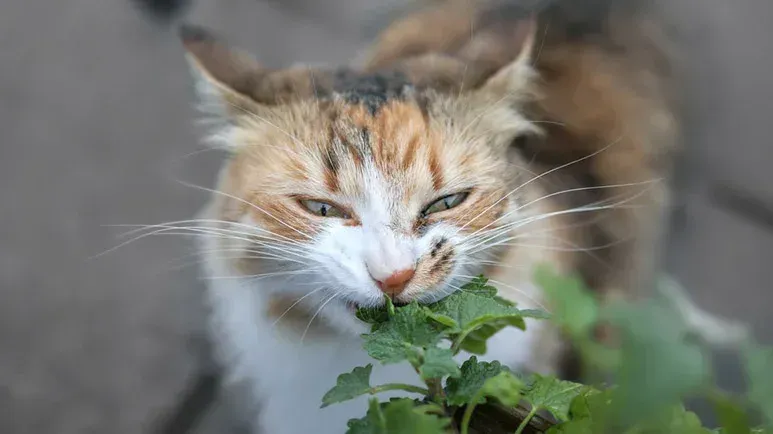
Here is an interesting fact most cat parents do not know: Sniffing and eating catnip can produce opposite effects. Sniffing lights up the olfactory system and tends to produce the energetic, playful, zoomie-driven response. Eating catnip, by contrast, tends to produce a calmer, almost sedative effect — think naptime instead of party mode. The ingested compounds may interact differently with the digestive tract than with the olfactory system, although some scientists believe the difference is that chewing the catnip volatizes a more potent dose of the nepetalactone into the mouth and therefore the scent receptors. Small amounts are perfectly safe to eat, though larger quantities can cause mild stomach upset.4,5
This is why the same catnip toy can trigger a wild rolling session one minute and a peaceful curl-up the next — it may depend partly on whether your cat is sniffing or munching.
Why Some Cats Do Not Respond
Sensitivity to catnip is actually genetic, and roughly 30% to 40% of adult cats simply do not have the gene that produces a response. Nothing is wrong with those cats. They are just not wired for it.
Kittens under three to six months rarely react either — the behavioral response usually does not emerge until closer to sexual maturity, generally around six months of age. If you have been trying catnip with a young kitten and getting zero reaction, that is completely normal.6,7
Alternatives Worth Trying
If your adult cat is a catnip non-responder, do not give up on the whole category. Several plants in other families create similar responses that can do the trick:8,9
- Silvervine (Actinidia polygama) — Probably the most important alternative, most Western cat parents have not heard of. It has been used in Japan for centuries as a cat stimulant, where cats' reaction is called the Matatabi Dance. Studies have found about 79% of domestic cats respond positively, including many who are unmoved by catnip.
- Tatarian honeysuckle wood — Effective in roughly half of cats. Comes in small wooden pieces that cats chew and drool on. Less tidy than catnip but satisfying for cats who enjoy it.
- Valerian root — Less predictable, working in about 47% to 50% of cats, but the stimulant effect can be intense for those who respond. One warning: valerian smells strongly unpleasant to human noses.
Offer these systematically rather than all at once — introduce one, watch the response over a few days, then try the next if there is no interest.
Fresh, Dried, or Spray Form?
Fresh catnip is significantly more potent than the dried variety because the nepetalactone has not had time to volatilize. A small pinch of fresh herb will produce a stronger reaction than a larger amount of dried. If you have the space, growing a plant indoors on a sunny windowsill is easy, inexpensive, and gives you a perpetual supply. Treat it roughly like you would a basil plant.
Dried catnip is more practical for most households. Keep it in an airtight container away from heat to preserve potency. Sprinkle it on a toy, a scratching post, or a small piece of fabric sewn into a pouch.
Catnip sprays are the best choice for cats who get stomach upset from ingesting the herb — they deliver the olfactory trigger without any consumption. Sprays are also useful for refreshing old toys that have lost their appeal.
Beyond Fun — The Real Health Benefits
For a plant that is mostly associated with silly rolling and five-minute play sessions, catnip’s range of practical uses is surprisingly broad — enough that integrative and holistic veterinarians increasingly treat it as a real tool in a cat's wellness routine rather than just a novelty herb:10,11,12
- Calming anxiety — For cats that get stressed before veterinary visits, car rides, or home renovations, a small amount of catnip 20 to 30 minutes beforehand can take the edge off. The post-euphoria phase tends to leave cats noticeably relaxed. Cats dealing with mild separation anxiety may benefit from a catnip-infused toy left out during your absence.
- Encouraging exercise — For indoor cats who may not get enough physical activity, catnip-infused toys or scattered dried leaves can be an enticing motivator to play — which supports healthy weight, longevity, and overall well-being.
- Digestive support — Catnip tea (brewed mild and cooled) has traditionally been used to soothe upset stomachs in cats, dogs, and people.
- Natural insect repellent — Studies have found catnip oil to be a surprisingly powerful mosquito deterrent — some research has suggested it rivals DEET for repelling insects.
- First-aid support — Catnip oil has antimicrobial properties and has been used topically for minor wounds and ear irritation in traditional applications.
That said, catnip is a tool, not a treatment. If your cat has persistent or severe anxiety, loop in your vet about a comprehensive plan rather than relying on catnip alone.
How Often Is Too Often
Overexposure to catnip leads to desensitization — the responses become weaker and shorter until eventually the cat stops reacting at all. To keep catnip effective, limit sessions to two or three times per week at most. Put catnip toys away between uses so they retain novelty. Think of it the way you would think of a special treat: valuable precisely because it is not always available.
The good news is that catnip is not addictive. Cats with unlimited access simply stop responding to it rather than developing any kind of dependency. However, make sure to keep these safety guidelines in mind:
- Never force catnip on a cat who shows no interest — there is no benefit, only unnecessary stress
- Avoid highly concentrated catnip essential oils, which can be overwhelming
- Monitor first-time exposures — occasionally a cat becomes briefly overstimulated or even aggressive
- If your cat vomits after eating catnip, switch to spray-only application
- Choose organic, additive-free catnip to avoid pesticide residues on something your cat will roll in and lick
- Start small — too much catnip can cause mild tummy upset
What About Dogs?
Some holistic pet retailers suggest catnip can benefit dogs — a sprinkle on food or a mild catnip tea for digestion and calming, or formulas that include catnip for stress support. However, other veterinary experts recommend keeping catnip away from dogs altogether because it can cause digestive upset, though it is not toxic to them.13,14
If you want to try catnip with your dog, start with a very small amount, watch closely for any digestive reaction, and talk to an integrative veterinarian about whether it is an appropriate addition to their calming routine. Dogs do not experience the sniff-driven euphoric response the way cats do, but the calmer, digestive-supporting applications may still work for some.
The Real Takeaway
Catnip is one of the genuinely enjoyable parts of living with a cat — a harmless, inexpensive, reliably entertaining ritual when used thoughtfully. Know your cat's response patterns. Keep sessions occasional enough that they stay meaningful. Pick good-quality organic catnip over mystery-source product. And if your particular cat is in the non-responsive 30% to 40%, do not take it personally — try silvervine or Tatarian honeysuckle, and you may discover an entirely new side of them.
Used well, catnip really can turn frantic zoomies into peaceful naptime. Just a tiny sprinkle, a toy flung across the room, and five to ten minutes of pure goofball joy — followed by the quiet contentment that makes living with a cat such a specific delight. There is not much else that costs almost nothing and delivers that much happiness in a single afternoon.
Sources and References
- 1 Midwest Invasive Species Information Network, Catnip
- 2,12 The Innocent Hound, The Ultimate Guide to Catnip: Exploring the Benefits of Catnip
- 3,5,6,8,10,14 Independence Veterinary Clinic, August 3, 2023
- 4,7,11,13 The Pet Beastro, March 21, 2025
- 9 BMC Vet Res. 2017 Mar 16;13(1):70. doi: 10.1186/s12917-017-0987-6

Better Health Begins in the Bowl

Better Health Begins in the Bowl
The Ultimate Pet Nutrition Guide was created to help dog and cat parents understand what truly supports lifelong health.
In this free guide, you’ll discover:
-

How your pet’s biology influences their nutritional needs
-
Why conventional feeding advice often falls short
-
Practical ways to choose better food for your dog or cat
View our Privacy Policy and Terms of Service.