This Ancient Plant Could Help Aging Joints
A tree resin used in traditional medicine for thousands of years is quietly earning respect in modern veterinary research — and for aging dogs, it may be one of the more genuinely useful additions to a well-designed care plan.
Reviewed by Dr. Tracy Duffner



Join the Bark & Whiskers™ Family
Sign up today for our FREE newsletter, packed with expert advice and insider tips to keep your beloved pet in tip-top shape.
View our Privacy Policy and Terms of Service.


STORY AT-A-GLANCE
- Boswellia serrata, also known as Indian frankincense, is a tree resin used for centuries in Ayurvedic medicine and is now backed by modern veterinary research for its ability to support joint health in dogs with osteoarthritis
- Its active compounds — boswellic acids, especially AKBA — work through a different anti-inflammatory pathway than NSAIDs, targeting the 5-LOX enzyme rather than cyclooxygenase, and also help protect cartilage by slowing enzymes that degrade collagen
- A landmark Swiss clinical trial found that 71% of dogs with chronic joint and spine disease showed improvement within two weeks of taking a standardized boswellia extract, with reductions in lameness, pain, and stiffness by the six-week mark
- Boswellia's strongest evidence comes when it is combined with complementary ingredients like undenatured type II collagen (UC-II), curcumin, glucosamine, chondroitin, or omega-3s — the multi-front approach consistently outperforms boswellia used alone
- Boswellia should not be given alongside blood thinners like aspirin, warfarin, or heparin, and should be avoided in pregnant or nursing dogs; always use a dog-specific product and consult your veterinarian before starting
Your dog used to bound off the couch. Now they pause, stretch, and take the long slow route down. They still love their walks, but they take a moment longer to get up in the morning. That first minute of stiffness after a long nap is starting to feel like a pattern rather than a one-off.
Aging joints are one of the most common reasons pet parents look for something gentler to help their dog. One of the plant compounds that keeps coming up in veterinary conversations is boswellia, a tree resin with an ancient history and a growing body of modern research behind it.
What Boswellia Actually Is
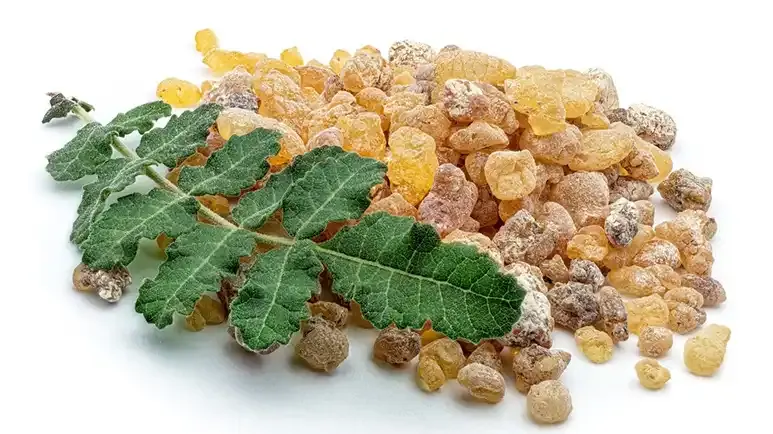
Boswellia, also known as Indian frankincense, is the resin extracted from the Boswellia serrata tree, native to India and the Middle East. For centuries, it has been part of traditional Ayurvedic medicine, prized for its anti-inflammatory and anti-rheumatic properties.1
Modern veterinary science has started to catch up with what those traditions long claimed. Boswellia is now one of the most extensively studied natural compounds for supporting joint health in dogs, and it shows up regularly in veterinary joint supplements.2,3
Traditional healers in India used the aromatic resin for everything from swelling to breathing issues. Contemporary researchers are exploring the effects of Boswellia not only in osteoarthritis and joint disease, but also cancer, viral infections, gut inflammation, and even anxiety behaviors.4 Osteoarthritis research has found that boswellia does do a specific job well: it helps to quiet the kind of chronic inflammation that shows up in arthritic joints.
How It Works
The active ingredients in boswellia are boswellic acids. Six different forms of these compounds have been identified in the resin, but one in particular does most of the heavy lifting: acetyl-11-keto-beta-boswellic acid (AKBA). AKBA works differently from the anti-inflammatory drugs most pet parents are familiar with.
Non-steroidal anti-inflammatory drugs (NSAIDs) target one specific enzyme pathway (cyclooxygenase). However, boswellic acids target a different pathway, an enzyme called 5-lipoxygenase, or 5-LOX, which is involved in producing leukotrienes. Leukotrienes are powerful inflammatory chemicals that can degrade joint tissue over time.
Because boswellia hits a different inflammatory pathway, it can complement conventional treatments rather than duplicating them. It also appears to have chondroprotective effects, meaning it helps protect joint cartilage by slowing the enzymes that break down collagen and other structural tissues.5
That combination — dialing down inflammation while also helping preserve the cushion inside the joint — is what makes boswellia genuinely interesting to veterinarians who work with arthritic dogs. It is not just a pain reliever; it is a tissue supporter as well.
What Canine Research Shows
A landmark Swiss veterinary trial gave 29 dogs with joint and spine disease a standardized boswellia extract at 400 milligrams (mg) per 10 kilograms (kg) of body weight daily for six weeks. Within just two weeks, 71% of the dogs showed overall improvement.6
By the end of the six-week trial, researchers noted meaningful reductions in lameness, localized pain, and stiffness. Since then, boswellia has been studied more often as part of multi-ingredient joint formulas. Here are other notable findings:7
- A 2022 trial tested a supplement combining boswellia with chlorophyll, green tea extract, glucosamine, chondroitin sulfate, hyaluronic acid, and type II collagen in dogs with osteoarthritis. The supplemented dogs showed less pain and fewer arthritis signs.8
- A 2023 study found that dogs with osteoarthritis receiving cannabis sativa oil, boswellia phytosome, and ginger had less pain, inflammation, and oxidative stress.9
- A 2024 randomized, double-blind, placebo-controlled crossover trial, researchers found that undenatured type II collagen combined with boswellia showed improved mobility in dogs with osteoarthritis.10
- A 2023 scoping review published in the journal Animals concluded that boswellia, especially when paired with other evidence-based ingredients, produces meaningful benefits for dogs dealing with osteoarthritis.11
The honest caveat: many of these studies used multi-ingredient supplements, which means the improvements cannot be pinned entirely on boswellia alone. What the research suggests is that boswellia works well as part of a thoughtful, well-designed joint support formula.
Synergistic Combinations
Some of the most compelling recent research looks at how boswellia performs alongside other joint-supporting ingredients. In the 2024 study mentioned above, for example, a supplement containing undenatured type II collagen (UC-II) and boswellia improved mobility in dogs with mild-to-moderate osteoarthritis within just four weeks, based on owner evaluations.12
The combination of boswellia and curcumin (the active compound in turmeric) has also received attention. Studies have found that pairing these two significantly improved joint function and reduced discomfort. Researchers point to their complementary anti-inflammatory mechanisms as the likely reason.13
This is worth knowing when you are shopping. A joint supplement that combines boswellia with ingredients like UC-II collagen, glucosamine, chondroitin, curcumin, or omega-3 fatty acids is more likely to deliver noticeable results than boswellia used entirely on its own.
The takeaway is not that boswellia alone is weak. It is that joint pain in dogs is usually a multi-faceted problem, and formulations that address several angles at once, and use synergistic ingredients, tend to outperform any single ingredient in isolation.
Safety and Side Effects
Boswellia has a generally favorable safety profile in dogs. The Swiss clinical trial reported only brief, reversible digestive changes in a small number of dogs, and only one of those was linked to the supplement itself. Long-term safety studies have found that properly standardized boswellia extracts are well tolerated at recommended doses.14 That said, side effects are possible. Reported ones include:
- Mild gastrointestinal upset (vomiting, diarrhea, or gas)
- A slight decrease in blood clotting times
- Occasional allergic reactions, which can develop even after weeks of use
Because sensitivities can develop over time with repeated exposure, it is worth watching your dog for any changes throughout the course of treatment, not just at the start.
Interactions Worth Knowing About
Just because something is natural does not mean it plays nicely with every other medication. Boswellia should not be given alongside drugs that affect blood clotting or platelet function, including aspirin, heparin, warfarin, and other blood thinners.
It should also be used with caution, or avoided entirely, in pregnant or nursing dogs, since safe use has not been established in those situations. Always share a full list of your dog's medications and supplements with your veterinarian before starting anything new.15,16
How to Give It
Boswellia comes in several forms: powders, capsules, and tablets. It can be given with or without food, ideally at the same time each day. Remember these practical guidelines:17,18,19
- Use a dog-specific product — Human boswellia supplements may contain ingredients, combinations, or dosages that are not appropriate for dogs. When possible, choose a supplement made specifically for pets.
- Look for standardization — Products standardized for AKBA content tend to deliver more consistent results. Advanced extracts with improved bioavailability can achieve stronger effects at lower doses.
- Check for quality markers — Supplements produced in National Animal Supplement Council (NASC) certified facilities that follow Good Manufacturing Practices (GMP) generally offer better assurance of ingredient purity and label accuracy.
- Be patient with the timeline — Most dogs show improvement within two to four weeks of consistent use, though some may take up to eight weeks to show significant changes. This is a supplement that rewards patience, not one that produces overnight results.
- And loop in your veterinarian — Boswellia is not a replacement for a diagnosis or a prescription treatment plan. If your dog is limping, painful, or struggling to move around, they need a proper veterinary evaluation first. Boswellia may then become part of that plan, but it should not stand in for it.
What Boswellia Is Not
It is worth being honest about the limits. Boswellia is not a miracle. It does not rebuild damaged cartilage overnight, and it is not a substitute for prescription pain medication in dogs with severe osteoarthritis.
It is also worth remembering that supplements in general receive less regulatory scrutiny than pharmaceuticals. The FDA does not review non-drug supplements for safety or effectiveness before they hit shelves, which is why quality markers and veterinary guidance matter.
What boswellia can be — with the right product, the right dog, and reasonable expectations — is a genuinely useful part of a joint care plan. That is a smaller claim than the marketing sometimes makes, and a bigger deal than most single herbal supplements can back up with actual research.
The Bigger Picture on Aging Joints
Boswellia works best as part of a broader strategy rather than a stand-alone fix. Dogs with aging joints tend to do best with a combination of approaches: weight management, moderate consistent exercise, comfortable orthopedic bedding, and, when appropriate, targeted supplements and veterinary-directed care.
If your dog is at the stage where you are starting to notice the slower mornings and the extra sighs when they settle down, that is the moment to have a conversation with your veterinarian. There is a lot that can be done to keep an aging body comfortable, and boswellia may earn a spot in that plan.
A supplement pulled from a tree resin used for thousands of years is a nice reminder that helpful ideas sometimes have very long roots. Combined with modern research, thoughtful formulation, and a good veterinarian, it becomes one more tool in the effort to give a beloved dog many more comfortable, mobile years.
Sources and References
- 1,3,5,13,14,16,19 BioPup, November 24, 2025
- 2,7,18 Chewy, June 16, 2026
- 4 Journal of Psychiatric Research, October 2026 Pages 381-390, Volume 201
- 6 Schweiz Arch Tierheilkd. 2004 Feb;146(2):71-9
- 8 PLoS One. 2022 Feb 16;17(2):e0263971
- 9 Nat Prod Res. 2023 Jun;37(11):1782-1786
- 10,12 PLoS One. 2024 Oct 30;19(10):e0305697
- 11 Animals 2023, 13(5), 870
- 15,17 VCA Hospitals, Boswellia

Better Health Begins in the Bowl

Better Health Begins in the Bowl
The Ultimate Pet Nutrition Guide was created to help dog and cat parents understand what truly supports lifelong health.
In this free guide, you’ll discover:
-

How your pet’s biology influences their nutritional needs
-
Why conventional feeding advice often falls short
-
Practical ways to choose better food for your dog or cat
View our Privacy Policy and Terms of Service.