The Eye Emergency Many Pet Parents Don't See Coming
This illness can steal your pet's sight in hours. Learn why most pet parents miss the warning signs.
Reviewed by Dr. Tracy Duffner



Join the Bark & Whiskers™ Family
Sign up today for our FREE newsletter, packed with expert advice and insider tips to keep your beloved pet in tip-top shape.
View our Privacy Policy and Terms of Service.


STORY AT-A-GLANCE
- Glaucoma is one of the most painful and vision-threatening eye diseases a dog or cat can develop — the pain may be comparable to a migraine headache, and the early signs can look deceptively minor
- The condition is not caused by your pet's eye making too much fluid; it is caused by drainage failure, which causes pressure to build inside the eye and damage the retina and optic nerve
- Time is critical — untreated glaucoma can cause irreversible blindness in just hours to days, and in cats, the cost is often their sight if it is not treated within the first 48 hours
- There are two forms — primary glaucoma is inherited and affects predisposed breeds, while secondary glaucoma is more common and develops from uveitis, lens dislocation, tumors, internal eye bleeding, or lens damage
- Sudden redness, cloudiness, a dilated pupil, squinting, bumping into walls, or pawing at the face should be treated as an emergency — call your veterinarian or head to an emergency clinic right away
It starts subtly, such as a little redness in the eye or some squinting. Your pet seems a bit off, or could be sleeping more than usual or pulling away when you touch the side of their head.
Most pet parents assume it is a passing irritation. The hard truth is that some of those signs can mean something much more serious — a painful, vision-threatening eye disease called glaucoma. And once it starts, the window to save your pet's sight can close in hours.
What Glaucoma Actually Is
Your pet's eye is filled with a clear fluid called aqueous humor. It is constantly being produced inside the eye and drained out through a tiny structure called the iridocorneal angle (also known as the drainage angle). As long as production and drainage stay balanced, the pressure inside the eye — called intraocular pressure, or IOP — stays normal.
Glaucoma happens when that drainage system fails. Fluid backs up and pressure builds. And the structures inside the eye, particularly the retina and the optic nerve, which carry visual signals to the brain, start to take damage.
It is important to know that glaucoma is not caused by the eye making too much fluid. It is caused by the fluid having nowhere to go.1,2
Why It Is a True Emergency
Glaucoma is one of the most painful and vision-threatening eye diseases pets can develop. One veterinary ophthalmologist describes the pain as similar to a migraine headache — a level of discomfort most pet parents probably cannot fully imagine. Pets in this kind of pain may rub or paw at their face, become lethargic, stop eating, or just hide.
The timing matters as well. If left untreated, glaucoma can cause irreversible blindness in just hours to days. Damage to the optic nerve is permanent — once vision is lost, it does not come back. In cats, vision is often impacted by the time symptoms are visible to the pet parents and,3 if the condition is not treated within the first 48 hours, the cost is often full loss of their sight.4,5
The 2 Forms of Glaucoma
Not all glaucoma is the same — and understanding which type your pet has shapes both the treatment plan and what to watch for in their other eye. Glaucoma comes in two main types:6,7
- Primary glaucoma is inherited or congenital — It happens in an otherwise healthy eye because of anatomical abnormalities in the drainage angle. Certain dog breeds are predisposed, and in cats, Siamese, Burmese, and Persian breeds are most commonly affected.8
- Secondary glaucoma develops because of another problem inside the eye or a systemic problem in the body —This is the slightly less common form in dogs,9,10 and the most common cause in cats, comprising more than 90% of cases.11 Triggers include:
- • Uveitis — Inflammation inside the eye, where debris and scar tissue block drainage; this is often secondary to a systemic metabolic or inflammatory disease such as diabetes or, in cats, FIV, FIP, or FeLV
- • Lens dislocation — The lens slips forward and physically blocks the drainage angle
- • Tumors or cancer inside the eye
- • Internal eye bleeding, where a blood clot can block drainage
- • Lens damage that releases proteins, sparking inflammation and swelling
Breeds and Animals at Higher Risk
Genetics plays a big role in who develops primary glaucoma, and that means certain breeds are at much higher risk than others. If you share your home with one of them, knowing the predisposition gives you a head start on watching for early signs. Many dog breeds are predisposed to primary glaucoma, including:12
- Cocker Spaniels (American and English)
- Basset Hounds
- Beagles
- Boston Terriers
- Chow Chows
- Great Danes
- Shar Peis
- Shih Tzus
- Siberian Huskies
- Akitas, Samoyeds, and many more
In cats, glaucoma is rarer overall but tends to affect middle-aged or senior cats in cases of secondary glaucoma. Siamese, Burmese, and Persians are most commonly hit when it comes to primary glaucoma. One thing to keep in mind is that glaucoma can affect only one eye at first. The other eye may stay healthy or develop the disease later. That is why a careful look at each eye matters, not just a glance at both together.13
Signs to Watch For
In acute glaucoma, the signs come on suddenly. In chronic cases, they build up more slowly and may have been present for some time before you notice anything is wrong. Either way, here is what to look for:14,15
- Eye pain (your pet may squint, partially close the eye, or rub at it)
- Turning away or flinching when you touch the side of their head
- Watery discharge
- Redness in the white of the eye
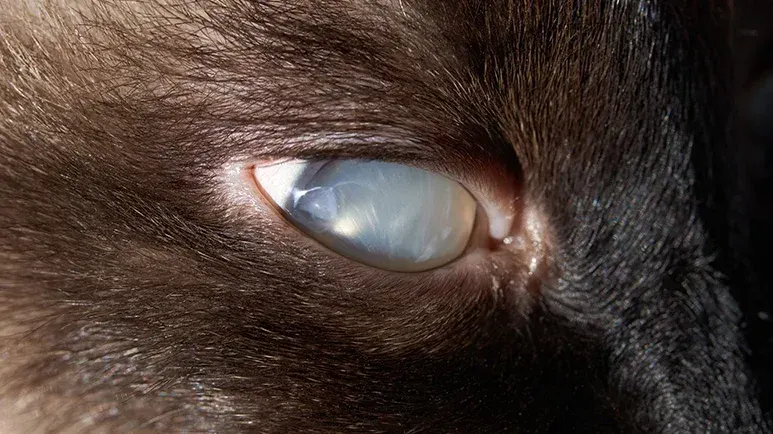
- A cloudy or bluish appearance to the cornea
- A dilated pupil that does not respond to light
- Visible swelling or bulging of the eyeball (especially in chronic cases)
- Sudden vision loss (bumping into walls or furniture, hesitating to move)
- Lethargy, loss of appetite, or general unresponsiveness
- Behavior changes in cats (sleeping more, eating less and being irritable)
If you see any combination of these — particularly the redness, cloudiness, sudden vision changes, or signs of pain — treat it as an emergency. Call your veterinarian or head to an emergency clinic right away.
How It Is Diagnosed
Glaucoma is diagnosed by measuring intraocular pressure with a device called a tonometer, along with an internal exam of the eye using specialized instruments.
For acute cases, your veterinarian may refer you to a veterinary ophthalmologist for the most specialized care. Time matters at this stage — the faster the pressure can be brought down, the better your pet's chances of keeping their vision.16
Treatment Options
Treatment focuses on two things at once: relieving the pain and bringing the pressure down as quickly as possible.17,18,19
Pain relievers help with discomfort, and prescription eye drops or oral drugs work to either decrease fluid production or promote drainage. Long-term medical therapy may involve carbonic anhydrase inhibitors or beta-adrenergic blocking agents. These medications are often a long-term commitment, not a short-term fix.
For severe or advanced cases, veterinary ophthalmologists may use various surgical techniques to lower pressure. These can include a glaucoma valve placement, a laser procedure, or — in eyes that have already lost vision — removal of the eye (enucleation) to end the pain. Some pets are good candidates for a prosthetic eye.
If secondary glaucoma is driving the problem — a tumor, severe uveitis, lens dislocation — addressing the root issue is critical.
The Long View
Glaucoma typically requires ongoing care. Once it is diagnosed, your veterinarian will likely want frequent follow-ups to make sure the treatment is working and to adjust medications as needed. Even with successful treatment, regular checkups remain important, because glaucoma can develop in the second eye over time, even if it started in only one.20,21,22
The prognosis depends largely on the underlying cause. Many pets do well with consistent care, especially when the condition is caught early.
How to Catch It Early
Glaucoma often appears without warning, so being proactive is your best defense. A few simple habits make a real difference:
- Schedule wellness exams twice a year, especially for senior pets and predisposed breeds.
- Pay attention to each eye individually — not just to the pair.
- Do not dismiss redness, squinting, or sudden behavior changes as “just a bad day.”
- Trust your gut — if something looks off about your pet's eye, get it checked.
The Bottom Line
Glaucoma is the kind of emergency that is easy to miss because it can look like something minor at first — a touch of redness, a little squinting, a quieter day than usual. But behind those small signs can be a level of pain your pet can't tell you about, and a clock that is already ticking on their vision.
The good news is that early intervention can save sight, relieve pain, and protect your pet's quality of life. The single most important thing you can do is take eye changes seriously and act fast.
If your pet's eye suddenly looks red, cloudy, or painful, do not wait. Make the call. With glaucoma, hours really can be the difference between vision saved and vision lost.
Sources and References
- 1,6,12,14,16,17,20 VCA Hospitals, Glaucoma in Dogs
- 2,4,19,22 Fetch, Glaucoma in Dogs and Cats – An Emergency You Shouldn’t Ignore
- 3 Cornell Feline Health Center, Feline Glaucoma
- 5,7,13,15,18,21 Eve Pet Hospital, Cats and Glaucoma: An Eye Emergency
- 8 Vet Ophthalmol. 2011 Sep;14(Suppl 1):15–29
- 9 Vet Ophthalmol. 2004 Jul-Aug;7(4):245-59
- 10 VETgirl, Guide to the Types of Glaucoma in Dogs and Cats
- 11 Vet Clin North Am Small Anim Pract. 2023 Mar;53(2):367-387

Better Health Begins in the Bowl
Better Health Begins in the Bowl
The Ultimate Pet Nutrition Guide was created to help dog and cat parents understand what truly supports lifelong health.
In this free guide, you’ll discover:
-

How your pet’s biology influences their nutritional needs
-
Why conventional feeding advice often falls short
-
Practical ways to choose better food for your dog or cat
View our Privacy Policy and Terms of Service.