If You Love Your Pet's Slobbery Kisses — Should You Worry About Infection?
Ever wondered what's hiding in your pet's kisses and whether it's cause for concern? Scientists don't have all the answers yet. What they do know is that a single lick can leave behind millions of bacteria. Here's what research has revealed about the potential risks so far.

Reviewed by Dr. Becker


Join the Bark & Whiskers™ Family
Sign up today for our FREE newsletter, packed with expert advice and insider tips to keep your beloved pet in tip-top shape.
View our Privacy Policy and Terms of Service.



STORY AT-A-GLANCE
- Some people love being “kissed” by their pet, while others don’t
- There’s lots of bacteria foreign to the human body in dog and cat saliva, and normally human skin provides an effective barrier against potential pathogens
- However, it’s important to keep in mind that bacteria in your pet’s saliva may present a threat if you have open sores on your skin
- It’s also possible for you to infect your pet, especially with E. coli bacteria that may be resistant to antibiotics
- It’s important to implement common sense safety measures to keep both human and four-legged family members safe from life-threatening bacterial infections
Editor's Note: This article is a reprint. It was originally published January 27, 2018.
People tend to be split right down the middle when it comes to their opinions on whether dogs and cats should be allowed to “kiss” their humans. Either they love the idea or hate it. Few are neutral on the subject!
One thing most pet owners can agree on, though, is that they don’t really know what’s in their pet’s saliva or if it presents a possible health risk. Fortunately, for those who love pup and kitty kisses, the skin and immune system usually provide an effective barrier against potential pathogens in pet saliva.
However, if there’s a break of any kind in your skin and your pet licks the area, in a worst-case scenario it can be devastating. An example: A woman in Australia had a superficial burn on her left foot and her dog licked the burn. She wound up with septic shock, and the culprit was Capnocytophaga canimorsus, a type of bacteria commonly found in the saliva of healthy dogs and cats.1
C. canimorsus is not a bug the human body recognizes, and once it entered the woman’s bloodstream, she had a hard time fighting it off. Fortunately, antibiotics eventually cleared the infection, but not before the poor woman lost her left leg below the knee, part of her right foot and all her fingers and toes.
Again, this is a worst-case situation and incredibly rare (so don’t panic!), but it’s important to remember that dogs and cats are not humans, and their bodies can harbor pathogens that are foreign and dangerous to the human body (and vice versa).
Your Pet’s Oral Bacteria Is Very Different from Yours
From 400 to 500 strains of bacteria have been identified in the human mouth, and to date, scientists have discovered around 400 strains in dogs and 200 in cats.2 The microbiomes of people and their pets are distinctly different, which is why people are at risk for infection when a dog or cat deposits saliva on them. Believe it or not, one lick of your pet’s tongue can leave behind virtually millions of bacteria your body doesn’t recognize, and those bugs have staying power.
“So if you’re licked by a dog,” says bacterial geneticist Floyd Dewhirst, Ph.D., in an interview with National Geographic, “and someone were to take a Q-tip five hours later and rub that spot, they would recover over 50 different species of dog-mouth bacteria.”3
And by the way, it’s a myth that pet saliva has an antibacterial effect in humans. There may be some protective properties in dog and cat saliva, but only for members of their own species.
Bacterial Infections You Could Conceivably Get from Your Pet
A common organism found in the mouths of both dogs and cats is pasteurella, which can cause infections of the skin and lymph nodes. Bartonella henselae are bacteria cats acquire from flea bites. Bartonella also resides in the mouth, and it can cause an infection known as cat scratch fever. In theory, these bacteria from your pet’s saliva can infect you.
However, most of these infections in humans are the result of bites or scratches. There is very little data pointing to a problem of transmission by pet kisses. Intestinal bacteria commonly found in dogs and cats (regardless of the type of food they’re eating) include E. coli, salmonella, clostridia and campylobacter.
These bugs don’t cause problems in healthy pets, but they can cause intestinal disease in humans. The bacteria are present in your pet’s poop. If your dog or cat licks his bottom, he could get bacteria in his mouth, which could then be transmitted to your skin. However, most human infections from these bacteria are the result of someone coming in contact with pet feces on their hands, and then touching their mouth or face. Little proof exists that pet kisses are a means of transmission.
Dog Parents May Be More Likely to Transmit This Bacteria to Their Dogs Than Vice Versa
Interestingly, humans carry more drug-resistant strains of E. coli bacteria than their dogs, according to a 2009 study that looked at how disease can be spread between owners and their dogs.4 The study results showed that in 10% of dog-human pairs, owners and their dogs shared the same E. coli strains, which had more resistance to antibiotics than expected.
The owners had more multiple drug-resistant strains than their dogs, indicating people are more apt to transmit multiple-drug resistant E. coli to their dogs than vice versa. Bonding behaviors between people and their dogs appeared to have no bearing on bacteria transmission. However, there was an association between antibiotic-resistant E. coli and pet parents who didn't wash their hands after handling their dogs or before cooking meals.
Parasitic Infections You Might Get from Your Pet
People may be more likely to transfer certain types of bacteria to pets, but pets are more likely to transfer certain parasites to people, because your dog or cat is a natural host for a variety of different parasites. If you should become infected, you could acquire any number of illnesses, from skin problems to brain disease.
And while these parasites may not make your pet sick, eggs passed in dog or cat poop can cause human infection. As in the case of bacteria, the primary method of transmission is fecal-oral. However, with only a couple of exceptions, this type of infection is improbable. Parasite eggs need to mature in feces or another contaminated environment in order to become infective.
Your dog would have to lick your face after having contacted poop with his mouth that was from one to 21 days old (depending on the parasite). Because most cats aren’t poop eaters, they are even less likely to transmit a parasite infection to their owners. The exceptions to this scenario are giardia and cryptosporidium, which are immediately infective when present in pet feces.
5 Common Sense Tips to Keep You and Your Pet Healthy
- Refuse unnecessary antibiotic treatment — Proceed with extreme caution if either you or your pet is prescribed antibiotics for any reason unless a culture and sensitivity has been completed, demonstrating it’s the correct choice. If your vet hasn’t identified what antibiotic will be the most effective at treating the infection, he or she is guessing, which is a bad idea.
Frequent and often unnecessary use of these drugs is causing antibiotic resistance in a growing number of bacteria strains. When antibiotics are no longer effective against serious bacterial infections, life-threatening consequences are the result. - Consider giving your pet a probiotic — A high-quality probiotic supplement will recolonize your pet’s digestive tract with healthy bacteria, boost her immune system and improve her overall health. This is especially important if your dog or cat has received antibiotic therapy.
- Cover open cuts, sores and skin abrasions on your skin — The real danger of pet saliva is with people who allow their dog or cat to lick an area of skin that is wounded and could allow bacteria into the bloodstream. So if you have any sort of injury to your skin, no matter how minor, either keep it covered around your pet or don’t allow him to lick you until the wound is fully healed.
- Practice good hygiene — Especially if you’re immunocompromised, the very best way to insure you and your pet don’t swap germs is to wash your hands before and after you handle your dog, and before touching food. Regular and thorough hand washing is a key to avoiding illness, no matter the situation. If your pet gives you kisses, wash your face (or wherever she licked you) after each smooch session.
Brush and bathe your dog regularly. A clean dog is more pleasant to be around, and you’ll also cut down on the dirt, allergens and bacteria she brings into the house on her body and especially, her feet. - Treat bites seriously — While bacteria from pet kisses are typically no cause for concern, bites definitely are. Immediate treatment is necessary, whether the bite is superficial or more serious. Clean the wound immediately with soap and warm water, rinsing thoroughly.
For superficial wounds, disinfect several times a day with dilute povidone iodine and cover the wound with a clean, dry dressing. Watch for signs of infection, including redness and swelling. If the bite is a deep puncture wound, seek medical attention immediately, as more intensive treatment may be required.
Sources and References
- 1 ABC Australia, July 24, 2008
- 2,3 National Geographic October 24, 2017
- 4 American Journal of Veterinary Research, September 2009

Better Health Begins in the Bowl
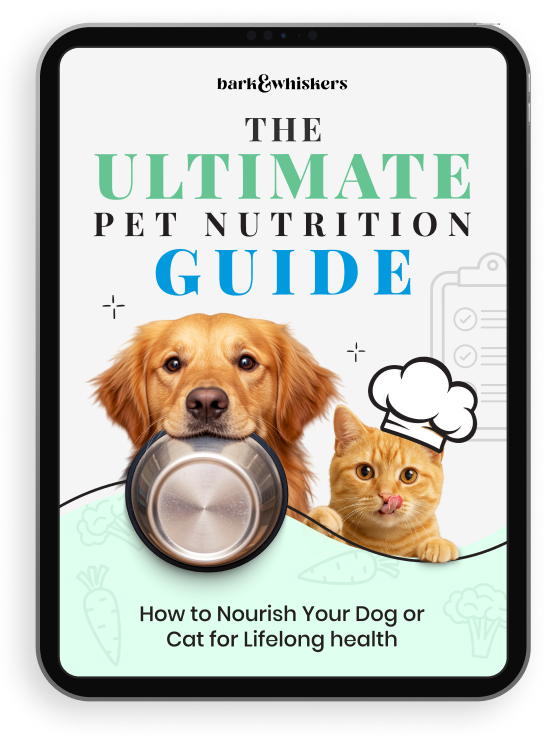
Better Health Begins in the Bowl
The Ultimate Pet Nutrition Guide was created to help dog and cat parents understand what truly supports lifelong health.
In this free guide, you’ll discover:
-

How your pet’s biology influences their nutritional needs
-
Why conventional feeding advice often falls short
-
Practical ways to choose better food for your dog or cat
View our Privacy Policy and Terms of Service.